Water-Efficient Plant Selection for Sunny Front Yards
A sunny front yard in the San Gabriel Valley can be a beautiful thing, but it can also be a demanding one. The heat reflects off pavement, the soil dries quickly, and a front yard sits in plain view long before anyone notices the care it takes to keep it healthy. That is why plant selection matters so much. The right plants can lower irrigation demand, soften hard surfaces, handle intense sun, and create a front entry that feels intentional rather than thirsty. The wrong plants can turn a front yard into a cycle of constant watering, patchy growth, and high replacement costs.
Water-efficient planting is not just about choosing anything labeled drought tolerant. In real landscape design, especially for California homes, success comes from matching plant water needs to the site, understanding the soil, reading the sun exposure honestly, and planning irrigation before the first shrub goes in. That approach is especially important in the San Gabriel Valley, where sunny exposures, foothill conditions, and hillside landscaping often call for tough, climate-appropriate plants that can do more with less water.
Start with the site, not the shopping list
One mistake I see over and over is beginning with the nursery aisle instead of the property itself. A front yard in full afternoon sun on a flat lot behaves very differently from one that slopes toward the street or sits beneath reflected heat from a driveway. Before you commit to any plant palette, look carefully at irrigation, soil, and exposure. California water guidance puts those same factors at the center of good landscape planning, and for good reason. If you skip that step, even excellent plants can struggle.
Soil texture changes everything. Fast-draining soils dry out quickly and favor plants that tolerate periodic stress. Heavier soils hold moisture longer, but they can also create drainage problems if irrigation is heavy or poorly spaced. Sun exposure matters just as much. A plant that performs well in bright morning light may scorch in a south-facing yard with reflected heat from concrete. Wind, slope, and proximity to hardscaping all change how much water a plant actually uses.
That is why water-wise landscape design begins with observation. Watch where the sun lands in midsummer. Notice which parts of the yard stay warm after sunset. Check whether runoff moves across the surface after rain or irrigation. On a hillside, those details are not cosmetic. They affect erosion control, plant survival, and long-term maintenance.
Water-efficient plants do best when their needs are grouped
The easiest way to keep a sunny front yard healthy without overwatering is to avoid mixing plants with very different water demands in the same bed. A low-water shrub beside a thirstier perennial tends to force a compromise, and the compromise usually means too much water for one plant and not enough for the other. Grouping plants by similar needs creates a more reliable irrigation pattern and reduces waste.
This is where drought resistant landscaping becomes more than a buzz phrase. It becomes a practical method. When plants with similar needs are clustered, irrigation can be tuned more precisely, mulch does more work, and the whole planting bed behaves more predictably through heat waves and dry spells. That matters even more in the California landscape context, where water-efficient planting is part of broader conservation and landscape regulation goals.
In a sunny front yard, the most durable choices are usually plants that can handle direct sun, leaner soils, and long dry intervals once established. California native plants are often a strong fit because they are adapted to local climate conditions, and many are already suited to the San Gabriel Valley’s hot, exposed settings. Climate-appropriate non-native plants can also work well if their water needs are low and their placement is thoughtful. The point is not native-only gardening at all costs. The point is using plants that match the conditions instead of fighting them.
What tends to work well in hot, exposed front yards
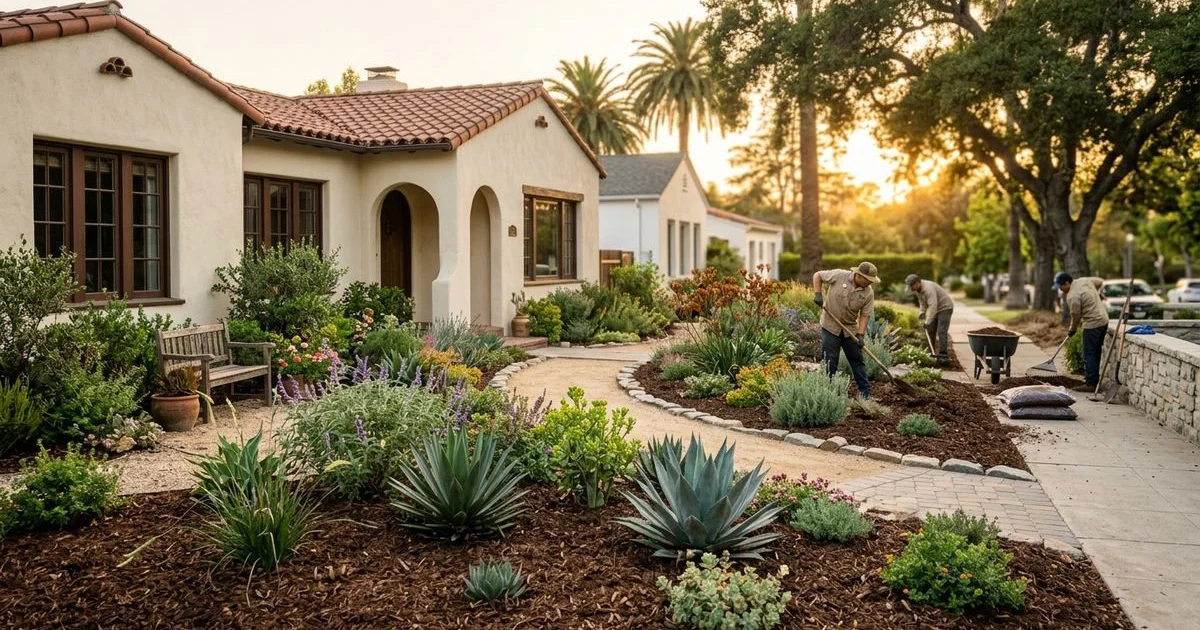
In this region, several plant types show up again and again because they offer both durability and visual structure. California buckwheat brings a light, open look and can hold a sunny slope beautifully. California sagebrush has a softer texture and thrives in dry, open conditions. Manzanita gives a front yard an evergreen backbone and can lend a strong architectural feel, especially where a more sculptural plant is useful near an entry. Ceanothus can bring color and form, though it should be matched carefully to the site and given the room it needs. Monkeyflower and foothill penstemon add seasonal interest without demanding constant irrigation. Bunchgrasses, when used with restraint, can give movement and reduce the need for thirsty lawn areas.
These are not just plant names on a palette. Each one solves a different design problem. California buckwheat can knit a slope together. Manzanita can act as a focal point. Ceanothus can screen and soften a wall. Bunchgrasses can bridge planting layers and help the yard feel less rigid. That layered approach is especially useful in hillside landscaping, where roots, drainage, and erosion control matter as much as appearance.
One thing to keep in mind is maturity size. A plant that seems modest in a container may spread wider or taller than expected. I have seen front yards become overcrowded because everything was planted for day-one appearance rather than year-three performance. Water-efficient landscape design should account for growth, not just initial curb appeal. A healthy, mature planting is usually more open and more elegant than an overstuffed one.
Design for sun, heat, and reflected glare
Sunny front yards do not just get direct sun. They often collect reflected heat from stucco walls, concrete walks, driveways, and retaining edges. That reflected heat can make one part of the yard significantly harsher than another. A plant that survives in open sun may still struggle if it sits inches from a heat-retaining wall. Small shifts in placement can make a major difference.
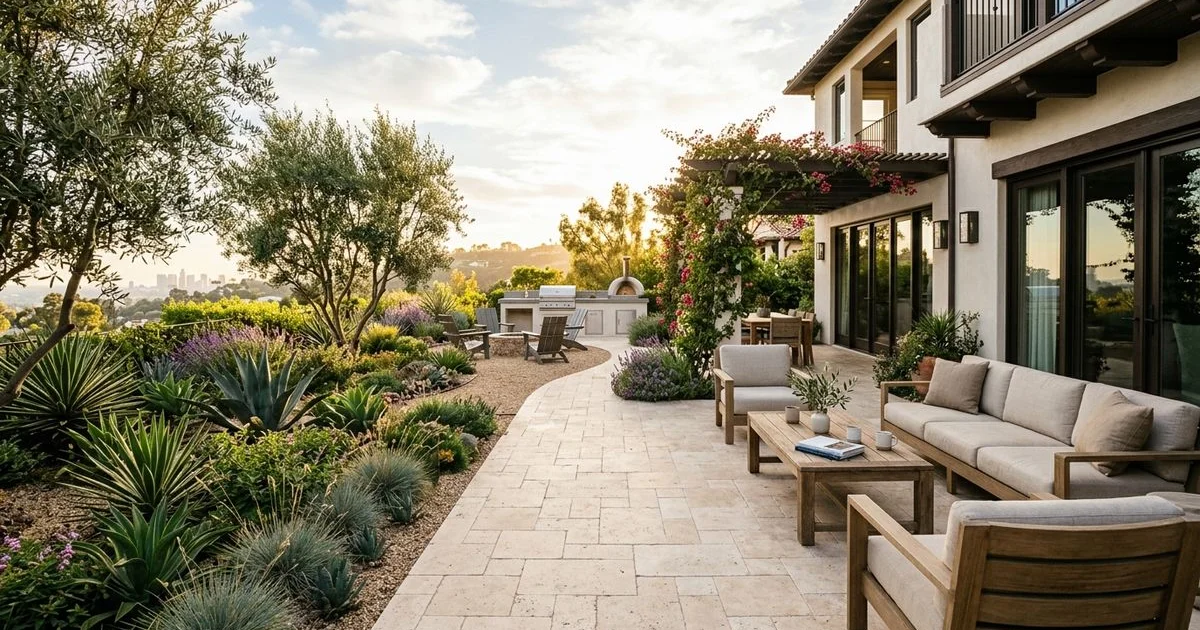
For example, a low-water shrub with fine foliage may appreciate a little air movement and room to breathe rather than being squeezed into a narrow strip of hot soil against paving. Meanwhile, a more tolerant groundcover might handle the edge zone near a walkway better than a shrub that needs deeper root space. Hardscaping should support the plant palette, not overpower it. In well-balanced landscape design, paths, steps, edging, and planting beds all work together to reduce the amount of exposed soil and unnecessary irrigation.
This matters in the San Gabriel Valley because front yards often have strong visual exposure from the street and a lot of hard edge conditions. A smart combination of planting and hardscaping can break up heat, guide runoff, and keep the yard looking finished without relying on a large irrigated lawn. That is one reason turf removal has become such a common part of water-efficient upgrades. Once turf is gone, the question becomes what replaces it. The best answer is usually not a single plant type, but a layered composition built for the site.
Turf replacement is a design decision, not just a conservation move
Removing turf saves water, but the replacement needs a plan. If the new landscape is built without attention to irrigation zones, soil preparation, or drainage, the result can be uneven and short-lived. California guidance emphasizes evaluating the site first, and that is especially true when turf is replaced in a sunny front yard.
A former lawn area can become a strong planting bed, a pollinator-friendly strip, or a more sculptural dry landscape. But the replacement should be matched to the actual conditions. Some homeowners assume that all no-lawn spaces should be planted densely. In practice, a better mix often includes planting pockets, mulch, and small areas of open hardscape to reduce water demand while keeping the design legible. That balance is often the difference between a yard that looks intentional and one that looks abandoned.
Efficient irrigation retrofits deserve equal attention. A front yard planted with water-wise species still needs well-designed irrigation, especially during establishment. Drip irrigation, properly zoned systems, and the ability to adjust watering as plants mature all help reduce waste. The healthiest low-water yards are rarely the ones with no irrigation at all. They are the ones with irrigation tuned to the planting.
Hillsides need a different strategy
Hillside landscaping introduces another layer of complexity. Slopes shed water quickly, which means runoff can carry soil downhill before roots have a chance to hold it. In those settings, plant selection has to support erosion control as well as water efficiency. CNPS guidance for hot, sunny slopes emphasizes drought tolerance and plants that help stabilize the site, and that advice fits the foothill conditions common in and around the San Gabriel Mountains.
For a sunny hillside front yard, the plant palette should favor species with root structures and growth habits that help anchor soil. Dense, aggressive watering is usually the wrong response. It can encourage shallow rooting and make erosion worse if water runs off before it can soak in. The better approach is to choose plants suited to the slope, space them so they can establish without overcrowding, and combine them with grading, mulch, or other erosion control measures as needed.
This is also where firewise thinking enters the conversation. In hillside areas, plant selection is not only about water savings. It is also about defensible-space planning and fire-resistant planting strategies. The San Gabriel Mountains and surrounding foothill areas have a landscape character shaped by native habitat and fire considerations. Native plants can fit beautifully into that setting when they are chosen thoughtfully and maintained responsibly. A water-efficient hillside front yard should feel like part of the region, not an imported idea pasted onto it.
A practical plant-selection lens for the front yard
When I evaluate plants for a sunny front yard, I ask a few basic questions before anything else: how much direct sun will it get, how much reflected heat is present, how fast does water move through the soil, and what role does the plant need to play in the design? A filler shrub and a focal shrub are not the same thing. A slope stabilizer and an entry accent are not the same thing. Water use should be weighed against function.
A useful way to think about the palette is in terms of layers. Lower plants can soften edges and reduce bare soil. Mid-height shrubs can create structure and rhythm. Taller accents can give the yard a sense of scale. Native bunchgrasses can bridge those layers without asking for much water. On a sunny property, that mix usually looks more natural and performs better than a row of identical shrubs.
Here is a short practical check before committing to plants:
- Match each plant to the sun exposure it will actually receive, not the gentler light of the nursery bench.
- Favor plants with similar water needs in the same irrigation zone.
- Use slope-friendly plants where runoff and erosion are concerns.
- Leave enough room for mature width and height.
- Choose species that support the yard’s firewise and water-wise goals at the same time.
That kind of selection process may sound cautious, but it saves money and frustration later. Replanting a failed front yard is more expensive than getting the palette right the first time.
Native habitat gardens can still look polished
Some homeowners worry that a native habitat garden will look too loose or too wild for the front of the house. That can happen, but it does not have to. The difference is often in structure. Clean edges, deliberate spacing, and a disciplined use of hardscaping can make a native planting feel polished without stripping away its ecological value.
In the San Gabriel Valley, that balance is especially relevant because the visual character of hillside and foothill neighborhoods often benefits from landscapes that feel grounded in the region. San Gabriel oak, California buckwheat, ceanothus, manzanita, and the other locally suited plants associated with the area can create a front yard that belongs to the site. If the layout is clear and the irrigation is efficient, the result is a landscape that looks thoughtful rather than overmanaged.
This is where hardscaping earns its place. A simple path, a few well-placed steps, or a modest retaining edge can make planting beds more readable and help control runoff. Hardscape should not dominate the yard, but it can reduce the amount of irrigated area and support the planting design. When used well, it gives a dry landscape a finished frame.
HOA rules, water restrictions, and what homeowners should know
Homeowners in HOA communities sometimes assume that rules prevent them from making water-efficient choices. That is not always the case. California water restriction guidance indicates that homeowners’ associations cannot prohibit certain water-efficient landscaping choices during drought-related restrictions. That matters for anyone planning turf removal, native planting, or irrigation upgrades in a front yard where HOA oversight is part of the picture.
Of course, that does not mean every design idea is automatically acceptable. Architectural review, setback rules, and neighborhood standards may still shape the final plan. But from a water-use perspective, the direction is clear. Water-efficient landscapes, drought tolerant landscaping, and climate-appropriate plant selection are not fringe options in California. They are increasingly part of responsible residential landscape planning.
The most defensible projects are the ones that can explain themselves. They reduce water use, fit the climate, address slope or erosion issues when present, and keep the front yard attractive in every season that matters. That is the kind of landscape that holds up in review and in real life.
The strongest front yards make water efficiency look normal
The best sunny front yards do not advertise their efficiency in a loud way. They simply look right. The plants are scaled to the site, the irrigation is quiet and appropriate, the slope is secure, and the hardscaping supports the planting instead of competing with it. Over time, the yard becomes easier to maintain because it was designed with the climate in mind from the start.
That is the real value of water-efficient plant selection. It is not only a response to scarcity, although water conservation is part hardscape and landscape specialists of it. It is a more careful way of thinking about landscape design. It recognizes the realities of sunny exposures, hillside conditions, and the San Gabriel Valley’s visual character. It respects the difference between a plant that survives and a plant that belongs. And it gives homeowners a front yard that can handle heat, use less water, and still feel welcoming every time they come home.