
How to Use Bunchgrasses in a Drought-Tolerant Landscape
Bunchgrasses earn their place in a water-wise garden because they solve several problems at once. They soften hard edges, help hold soil on slopes, and give a landscape movement that stays interesting long after a lawn would have browned out. In a region like the San Gabriel Valley, where hillside landscaping, firewise planting, and drought resistant landscaping often overlap, bunchgrasses are not just a decorative choice. They are a practical tool for building a landscape that looks settled, handles heat, and uses water more carefully.
The best bunchgrass plantings rarely happen by accident. They come from thoughtful landscape design, a clear reading of the site, and an honest look at how the space is used. Before turf comes out or a planting plan is drawn, the first questions should be simple ones: how much sun does the area get, what does the soil do after rain or irrigation, where does water collect, and where does it run off? California’s water guidance for landscape planning points people toward exactly that kind of assessment, and for good reason. A bunchgrass that thrives on a hot, open slope may fail in a dense, shaded corner that stays damp. The plant is only half the equation. The site does the rest.
Why bunchgrasses fit drought-tolerant gardens so well
A bunchgrass grows in clumps rather than spreading into a continuous carpet. That growth habit is part of its value. Instead of demanding the regular mowing, edging, and frequent irrigation of turf, bunchgrasses offer structure with far less maintenance. They break up broad hardscaping, frame paths, and create rhythm in a planting bed without asking for much beyond establishment watering and the right placement.
Their form also makes them useful in drought-tolerant landscaping because they read as intentional even when the garden is lean. A few clumps can carry a border that would otherwise feel bare. Taller selections can provide screening or movement near a driveway, while smaller ones can stitch together natives around shrubs such as California buckwheat, California sagebrush, ceanothus, or monkeyflower. On a hillside, they do a quieter but equally important job by helping anchor the planting with fibrous root systems and by interrupting the visual sweep of bare soil.
There is also a practical reason designers keep returning to them. Bunchgrasses tolerate the kind of variable conditions common in California landscapes, where one side of a yard may be blazing hot and another may sit in reflected shade from a wall or fence. That flexibility matters in microclimate-driven planting. A good plan does not treat the yard as one uniform field. It places plants where they can handle the actual conditions on the ground.
Start with the site, not the plant palette
When people are eager to replace turf, they often begin with a plant list. That is backwards. A more durable plan starts with the site itself. On many San Gabriel Valley properties, the important variables are slope, drainage, irrigation coverage, sun exposure, and whether the landscape sits near a fire-prone edge or a more sheltered courtyard. Those conditions shape what bunchgrasses will do in the landscape.
A hot south-facing slope is not the same as a level front yard. A slope dries faster, sheds water more quickly, and puts plants under more stress after the first warm season. That is where hillside landscaping principles matter. You want plants that can tolerate leaner irrigation, help reduce erosion, and fit into a layered design that does not invite runoff. Bunchgrasses are useful here because they can be planted in drifts that catch soil and visually stabilize the slope without creating a thirsty monoculture.
Drainage deserves special attention. Some soils drain too quickly and leave roots parched between irrigation cycles. Others compact and hold water longer than they should. In either case, the same plant may perform differently from one corner of the yard to another. California’s landscape planning guidance emphasizes checking soil conditions and irrigation before making major changes, and that is exactly the sort of work that saves money later. If you know which areas are dry, which are wet, and which are blasted by afternoon sun, you can place bunchgrasses where they belong instead of forcing them to adapt to the wrong spot.
Using bunchgrasses as structure in landscape design
In a thoughtful landscape design, bunchgrasses do more than fill space. They create structure. Their upright or arching leaves can act almost like living punctuation marks, leading the eye through a bed or anchoring the corner of a path. In smaller yards, that structure matters because you may not have room for large shrubs or layered tree canopies. Bunchgrasses offer definition without bulk.
They also work well with hardscaping. A clean line of decomposed granite, a retaining wall, a stair landing, or a boulder arrangement can feel severe on its own. Add bunchgrasses, and the space begins to breathe. The blades catch light, the seed heads move in the breeze, and the hard edges start to feel intentional rather than stark. That combination is especially effective where patios, walkways, and low walls need to blend into drought resistant landscaping instead of dominating it.
One of the most useful things about bunchgrasses is that they can bridge styles. In a modern setting, their simple texture complements concrete, steel, or gravel. In a more naturalistic garden, they echo the movement of native shrubs and wild slopes. I have seen them used in both settings to solve the same problem, which is how to keep a water-wise garden from looking overdesigned or sparse. The answer is often to repeat them. A few isolated clumps can look accidental, but repeated at measured intervals, they create cadence.
On slopes, bunchgrasses earn their keep
Hillside landscaping in Southern California is not a niche concern. It is a reality for many properties near the foothills and in neighborhoods shaped by slope and runoff. On those sites, the goals are usually the same: hold soil, slow water, reduce maintenance, and keep the planting compatible with firewise concerns. Bunchgrasses fit neatly into that set of priorities.
Their clumping habit leaves room between plants for runoff to slow down and sink in, especially when the site is designed to capture water rather than send it straight downhill. They do not solve erosion by themselves, but they help make a slope more resilient when combined with proper grading, mulch, and careful plant spacing. They are also visually lighter than dense shrub masses, which can be an advantage on a steep property where a heavy planting palette can overwhelm the site.
The trick is spacing. If bunchgrasses are planted too far apart on a slope, the ground can remain exposed longer than is wise. Too close together, and they can compete for water and begin to look crowded as they mature. The right spacing depends on the species and the scale of the slope, but the principle is the same: plant with the mature form in mind, not the nursery pot size. It is easy to underestimate how much a clump will widen in a year or two. A planting that looks sparse in month one may be perfectly balanced by year three.
Firewise considerations matter here too
In many parts of the San Gabriel Valley, firewise planting is not an abstract idea. It is part of ordinary landscape planning. The presence of fire-resistant planting, ember-aware design, and defensible-space thinking shapes how people plant near homes, fences, and structures. Bunchgrasses can play a helpful role because they can be used as part of a broader strategy that favors drought-tolerant, well-spaced, and lower-fuel plantings.
That does not mean every grass is automatically the right grass. Plant selection still matters. A bunchgrass should be chosen for the site, the microclimate, and the surrounding plant community. Around a home, the goal is not to create a dry, brittle-looking desert effect. It is to build a landscape that is orderly, irrigated responsibly, and compatible with the local planting context. Native and climate-appropriate plants matter here because they tend to fit the region’s conditions more naturally and support a more coherent planting scheme.
The local reference points are useful. California buckwheat, California sagebrush, manzanita, ceanothus, monkeyflower, foothill penstemon, and bunchgrasses all belong to a plant vocabulary that feels at home in the San Gabriel Mountains region and adjacent landscapes. Those plants give a garden texture and regional identity without pushing water use beyond what makes sense for the climate. In a fire-conscious setting, they also avoid the visual mismatch that comes with trying to force a lush, high-water garden into a dry, exposed property.
Turf removal is where bunchgrasses often shine
For homeowners planning turf removal, bunchgrasses often become one of the most useful replacements. They do not try to imitate a lawn. That is the point. Lawns require Pasadena landscaping companies a different maintenance rhythm, different irrigation, and a different visual expectation. If you pull out turf and then insist on a lawn-like feel, you usually end up fighting the site. If you accept a more layered composition, bunchgrasses can help create a garden that feels complete without pretending to be something else.
California water planning guidance encourages people to look closely at irrigation, soil, sun exposure, and plant selection before removing turf. That sequence is practical. It keeps the project from turning into a cosmetic swap that fails under real conditions. Once irrigation is sorted and the site is understood, bunchgrasses can be woven into the new layout as a structural layer. They are especially effective when paired with mulch and a mix of shrubs and perennials that vary in height and texture.
The transition from turf to drought-tolerant landscaping also changes how you think about maintenance. Instead of weekly mowing and high summer irrigation, you are usually looking at seasonal touchups, occasional cleanup, and more attention to plant spacing and establishment. That shift is not just about saving water. It is about changing the character of the yard so that it works with the climate instead of against it.
How to choose the right bunchgrass for the right spot
Not every bunchgrass belongs everywhere. Microclimate matters, and so does scale. A compact front entry planting wants a different character than a broad slope or a long, narrow side yard. Some bunchgrasses have a more refined texture and suit tighter spaces. Others read more boldly and can anchor large open areas or long runs of planting.
A useful way to think about selection is to start with function. Ask whether the grass needs to soften hardscaping, screen a view, stabilize a slope, or fill space between shrubs. Then consider exposure. Full sun, reflected heat, and wind are different stressors. Then look at irrigation zones. A plant placed in a low-water area should not be expected to behave like one near a downspout or a regularly irrigated border.
A small practical habit can save a lot of trouble later. Before planting, stand in the yard at different times of day and watch where the light hits, where the soil dries fastest, and where the wind moves through the space. That kind of observation sounds simple, but it often reveals why one part of the garden always struggles. Bunchgrasses succeed when they are matched to those patterns, not when they are forced into a generic planting grid.
A short planning checklist for using bunchgrasses well
If you want the planting to last, these are the decisions that matter most before you dig:
That kind of restraint usually produces a better garden than trying to squeeze in too many species. It also makes irrigation simpler, which matters when the goal is water efficiency rather than ornamental abundance.
Working with HOA rules and local constraints
In some neighborhoods, the challenge is not only horticultural. It is regulatory. Homeowners’ associations can complicate landscape changes, yet California water restrictions and related guidance limit how much an HOA can block certain water-efficient landscaping choices during drought-related restrictions. That is useful to know if you are planning turf removal or shifting toward native and climate-appropriate plants.
This matters most when a project is visible from the street or is part of a larger community standard. Bunchgrasses often help because they can look refined enough for a formal setting while still meeting the practical needs of drought resistant landscaping. A well-composed planting of bunchgrasses, shrubs, and ground layer plants can satisfy design expectations without reverting to water-heavy turf. On a street with a strong visual character, that balance is often what keeps the project approved and attractive.
Native habitat gardening without sacrificing order
Some gardeners worry that native habitat gardening will look too wild or unmanaged. That is usually a question of composition, not plant choice. Bunchgrasses are one of the easiest ways to bring a native garden into a more deliberate shape. Their repetitive form creates order. Their texture keeps the planting from feeling rigid. And when they are paired with local natives, the result can feel both rooted and refined.
The San Gabriel Mountains region is particularly rich in native plant interest, and that context matters for landscapes below the foothills as well. A garden that borrows from the local palette often settles into the land more gracefully than one built around plants that need a different climate or more frequent irrigation. Bunchgrasses contribute to that sense of place. They may not be the showiest plants in the bed, but they often do the structural work that lets the rest of the planting succeed.
A good landscape does not ask every plant to be a star. Some plants hold the line, hide awkward transitions, and make the design legible. Bunchgrasses are often those plants. They carry a site through summer heat, support a more efficient irrigation plan, and let hardscaping and softer plant textures coexist without tension.
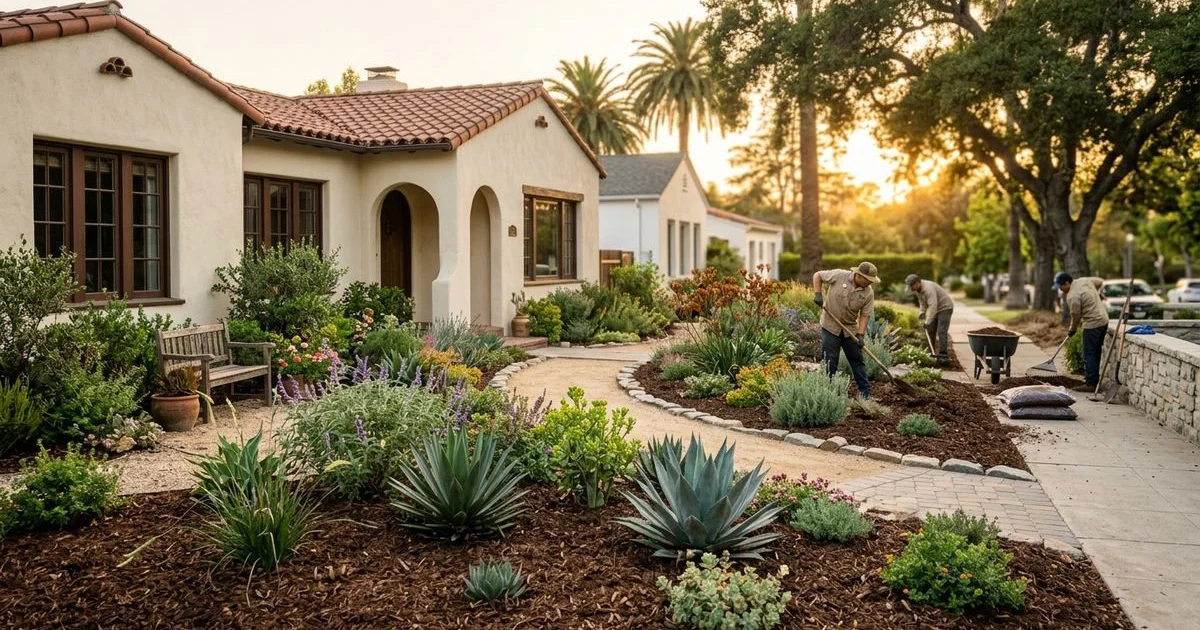
A drought-tolerant landscape built around bunchgrasses feels different from a lawn replacement project done on the cheap. It feels considered. It handles the realities of slope, fire, drainage, and water use without losing its sense of composition. That is why bunchgrasses have become such a reliable part of landscape design in California. They are modest plants, but they do serious work, and in the right place they make the whole garden look more settled, more regional, and more resilient.