
How to Design Around Sun Exposure in Drought-Tolerant Landscapes
Sun exposure drives more design decisions in a drought-tolerant landscape than most people expect. It affects which plants survive, how quickly soil dries out, where irrigation is worth installing, and how hardscape can either help or hurt the overall performance of the site. In the San Gabriel Valley, where hillside landscaping, warm slopes, and intense summer sun are part of the visual character of many properties, ignoring light conditions usually leads to wasted water, patchy plant health, and a landscape that looks tired long before it should.
A good drought resistant landscaping plan does not start with plant shopping. It starts with reading the site honestly. Where does the sun hit from morning to late afternoon? Which areas are exposed on a south- or west-facing slope? Where do walls, fences, trees, or the house itself create pockets of shade? That kind of assessment sounds basic, but it is the difference between a landscape that settles in and one that constantly asks for repairs.
Sun exposure is a design problem, not just a planting note
A lot of homeowners think about sun in terms of labels, full sun, part shade, shade. Those categories matter, but they do not tell the whole story. A spot that gets six hours of gentle morning light behaves very differently from one that bakes in reflected afternoon heat off a stucco wall or a paved courtyard. The same plant can perform beautifully in one and struggle in the other, even if both technically qualify as full sun.
That is why water-conscious landscape design in California starts with a broader site reading. State guidance emphasizes assessing irrigation, soil, sun exposure, and plant selection before removing turf. That order matters. If you strip out grass first and sort out exposure later, you can end up replacing one thirsty problem with another. The goal is not just to reduce water use, it is to place each element where it can do its job with the least friction.
Sun also changes the way a landscape feels. A hot, open front yard can become harsh if everything is low and exposed. A hillside can look elegant and stable if the planting pattern respects the slope and the sun. In that sense, sun exposure is both a horticultural issue and a landscape design issue. It affects performance, but it also shapes mood, proportion, and comfort.
Start with microclimates, not assumptions
The smartest drought-tolerant landscapes are rarely uniform. They are built around microclimates. A microclimate can be as small as the space beside a retaining wall, the narrow strip along a driveway, or the downhill edge of a slope where water drains fastest. These differences matter because soil moisture, heat, and reflected light change quickly from one zone to the next.
In hardscaping, for example, a light-colored patio may reflect more heat onto nearby planting beds than a darker surface would. A stone wall can create a hot pocket during the afternoon, while the north side of the same wall stays cooler and more forgiving. Even a modest overhang can create a transition zone that allows a broader plant palette than the rest of the yard.
This is where landscape design becomes less about filling space and more about matching conditions. If the front of the yard gets relentless sun, it may be the right place for California native plants that are adapted to heat and seasonal drought. If the side yard stays shaded longer, it can support a different set of plants and a different irrigation pattern. Designing around those differences helps the entire landscape use water more efficiently.
In practical terms, that means walking the site at different times of day before making decisions. Early light, midday heat, and late afternoon glare each tell a different story. A landscape that looks manageable at 9 a.m. Can feel punishing by 3 p.m.
Soil and slope shape how sun exposure behaves
Sun does not act alone. Soil and slope change everything.
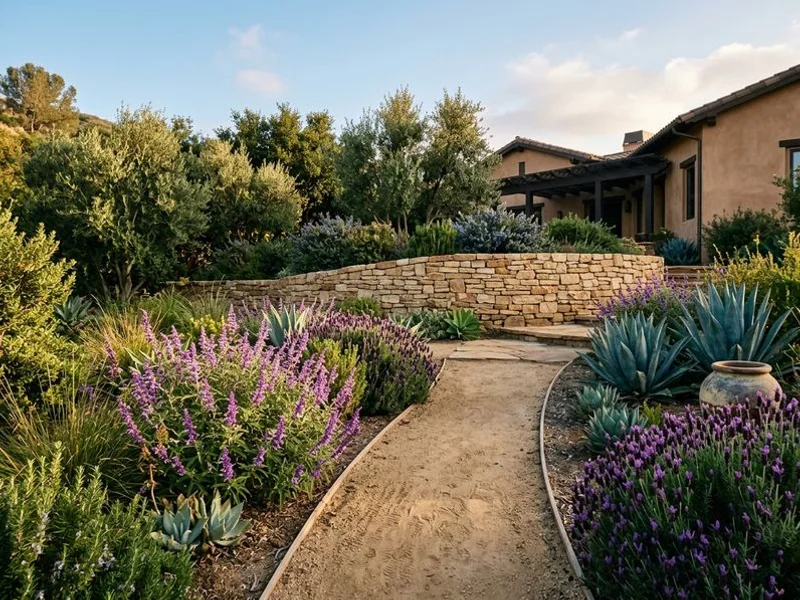
On a flat site, water may linger a little longer after irrigation or rainfall. On a slope, especially in hillside landscaping, water runs downhill before roots have much time to capture it. Add sun exposure to that equation and the upper portions of the slope can dry out much faster than people expect. Lower areas may hold more moisture, but they can also collect runoff and become uneven if drainage is not handled carefully.
This is why erosion control belongs in the same conversation as plant choice. The California Native Plant Society has long emphasized that slopes need drought tolerance, erosion control, and firewise planting. That combination is especially relevant in foothill neighborhoods and hillside properties where visual character and site function are tightly linked. A slope that is well planted and structurally sound does more than save water. It protects soil, supports drainage, and holds the whole composition together through hot seasons.
The soil itself also changes how sun stress shows up. Sandy or fast-draining soils dry out quicker, which can make a sunny zone more demanding than it appears. Heavier soils can retain moisture longer, but they still warm up under strong sun. That is why a blanket approach rarely works. Two beds with the same irrigation schedule can perform very differently if one sits in an exposed west-facing corner and the other is partly protected by a building or tree canopy.
Plant selection should follow exposure, not fashion
In drought-tolerant landscaping, plant selection is where good intentions often break down. Someone falls in love with a plant at a nursery, then forces it into the wrong exposure because it looked healthy in a container. The result is usually constant correction, extra irrigation, and more pruning than the plant should need.
The better approach is to build from the site outward. For the San Gabriel Valley, that often means leaning on California native plants and other climate-appropriate choices that can handle sun, seasonal dryness, and local conditions. The California water agency points gardeners toward WUCOLS for understanding region-appropriate plant water needs, which is useful because water use is not the same across every species, even when they all get marketed as drought tolerant.
That distinction matters. Some plants tolerate full sun and low water once established, while others only tolerate that combination if the soil, exposure, and irrigation are carefully managed. Matching the plant to the microclimate can reduce stress on both the landscape and the irrigation system.
Several regionally appropriate plants naturally suit this kind of design thinking, including California buckwheat, California sagebrush, manzanita, ceanothus, monkeyflower, foothill penstemon, and bunchgrasses. San Gabriel oak is also a locally named native species that fits the broader native habitat conversation. These plants are not interchangeable, and they do not all occupy the same niche. Some are better for open sun, some bring texture and seasonal movement, and some work especially well in restoration-minded or habitat-forward plantings. But they share a useful trait, they make sense in a climate where water efficiency and heat resilience are design priorities.
Native plant choices also help the landscape feel rooted in place rather than generic. In the San Gabriel Valley, that matters. The area’s hillside visual character deserves plantings that look like they belong there, not just like they survived a shopping list.
Hardscaping can either relieve heat or make it worse
Hardscaping deserves more attention in drought resistant landscaping than it usually gets. Surfaces, walls, steps, seat walls, and paved areas all change how sun works across the site. They can create structure and reduce maintenance, but they can also intensify heat if they are placed carelessly.
A hot hardscape near a planting bed can dry out the soil faster and shorten the window in which irrigation is effective. Large expanses of paving can reflect light onto nearby plants, particularly in west-facing areas that already get aggressive afternoon sun. On the other hand, well-placed hardscaping can break up a slope, slow runoff, and create usable spaces that reduce the need for turf.
That trade-off is worth thinking through honestly. A patio may be the right choice where a lawn would have struggled forever. A retaining wall may protect a planting area from erosion and help define irrigation zones. A gravel path can soften visual transitions and reduce water use where a planted strip would be difficult to maintain. But each hardscape element should be chosen with heat, drainage, and maintenance in mind, not just aesthetics.
In many projects, the most successful design uses hardscaping as a framework, then layers drought-tolerant planting where light and soil conditions support it. That makes the landscape feel deliberate instead of overbuilt. It also keeps the sunny parts of the yard from becoming barren simply because they are difficult.
Firewise planning and sun exposure often point in the same direction
Sun exposure and firewise landscaping overlap more than many homeowners realize. Hot, dry, exposed areas are often the same ones that need careful plant spacing, thoughtful material choices, and clear defensible-space planning. The CNPS San Gabriel Mountains chapter highlights ember-resistant zone rules and native plants suitable for local gardens, which is a useful reminder that fire safety and water efficiency are not competing goals.
In practical terms, this means avoiding overly dense plant masses near structures, paying attention to how dry material accumulates, and choosing species that fit both climate and safety considerations. Fire-resistant planting is not about creating a sterile yard. It is about arranging plantings so they are not pressing against the house, crowding narrow passages, or creating unnecessary fuel where sun and wind already create stress.
This is where local context matters. The San Gabriel Mountains are habitat for many rare, threatened, and endangered species, and the surrounding landscape carries that ecological weight. A firewise, water-wise design can still support habitat when it uses the right plants in the right places, with enough room for growth and enough structure to manage maintenance.
Sun exposure influences all of that. A high-heat area near the house may be better suited to lower, more controlled planting than a taller, denser grouping. A slope exposed to strong afternoon sun may need plants that stay tidy and resist flopping rather than species that create too much bulk. The design goal is stability, not visual volume.
Irrigation should be zoned by exposure, not convenience
One of the easiest mistakes in drought-tolerant landscaping is grouping plants by where they fit on the plan rather than by how much water and sun they actually receive. That leads to overwatering in some areas and chronic stress in others. Efficient irrigation depends on zones that reflect real site conditions.
The California landscape guidance is clear that irrigation should be assessed alongside soil, sun exposure, and plant selection. That combination is not bureaucratic detail, it is the foundation of a landscape that can be maintained without constant course correction. If a sunny slope dries out faster than a sheltered bed, they should not share the same watering assumptions. If a hardscape edge bakes all afternoon, it may need different emitter placement than a shaded pocket along the house.
Retrofits often make a big difference here. Reworking irrigation to match exposure can be more valuable than adding more water. Drip systems, adjusted schedules, and targeted coverage reduce waste when they are designed around the site’s actual behavior. In some cases, the right move is to reduce irrigation complexity rather than expand it. The landscape benefits because the plants receive water where roots can use it, not where it simply runs off or evaporates.
That said, no irrigation system can fully compensate for a plant that is badly placed. If a species that prefers less intense sun is stuck in a hot west-facing bed, the system will only prolong the problem. The design still has to be right.
HOA rules do not erase water-efficient choices
For many homeowners, one of the first questions is not horticultural. It is administrative. Can the association push back on the landscape style, the turf removal, the planting change, or the shift toward native plants? In California, drought-related water restriction guidance says homeowners’ associations cannot prohibit certain water-efficient landscaping choices during drought-related restrictions.
That matters because a lot of sound landscape design gets delayed by uncertainty. Homeowners assume they need approval for every water-wise change, so they keep the existing layout longer than they should. Meanwhile, the old turf stays in place, irrigation stays inefficient, and the site continues to demand more water than it needs.
Of course, HOA rules still affect appearance, maintenance, and sometimes plant selection, so it is smart to review local requirements carefully. But the larger point is that drought-tolerant landscaping is not a niche preference. It fits into a broader California framework that recognizes water conservation as a legitimate design goal. The best projects respect neighborhood character without sacrificing efficiency.
A sun-smart landscape usually starts with restraint
When a yard is overexposed, the temptation is to overfill it. People add more plant types, more irrigation lines, more decorative elements, and more visual layers to soften the harshness. Sometimes that works. Often it just creates clutter.
Restraint usually makes a better landscape. A few well-placed species, repeated thoughtfully, can do more for a sunny site than a crowded mix of plants that all want different conditions. In hillside landscaping, especially, repetition helps bind the slope visually and makes maintenance more predictable. It also reduces the chance that one underperforming plant will throw off the whole scheme.
That does not mean every area should look the same. A landscape can still have variety in texture, form, beautiful, functional landscapes and seasonal interest. Manzanita reads differently from California buckwheat, and bunchgrasses bring motion that broadleaf shrubs do not. Monkeyflower and foothill penstemon can add color and fine detail where the sunlight is strong enough to support them. The point is to use those differences with intention, not scatter them randomly.
A restrained design also ages better. Sunny landscapes tend to expose weak decisions quickly. If the structure is clear and the plant palette suits the conditions, the garden settles into itself instead of constantly being rebuilt.
Designing for the long summer, not just the first season
The hardest part of drought resistant landscaping is not installation. It is the second and third summer, when the site is no longer freshly mulched or newly planted and every mismatch becomes obvious. That is when a sunny bed reveals whether the plants truly fit the exposure, whether irrigation zones were laid out sensibly, and whether hardscaping is helping or intensifying heat.
A professional eye pays attention to those long-term behaviors from the beginning. Where will runoff go after a rare storm? Which slope edges dry first? Which surfaces throw heat back onto plants? Which zones need native habitat gardening and which zones need more controlled, structural planting? These are the questions that keep a design from becoming a maintenance burden.
The San Gabriel Valley offers a particularly clear test case because so much of its landscape identity is shaped by sunlight, hillsides, and water stewardship. The best projects do not fight those conditions. They use them. They respect the bright exposures, stabilize the slopes, bring in climate-appropriate plants, and make water work harder through smarter placement rather than greater volume.
A landscape designed that way feels settled. It holds its shape in strong sun, uses irrigation with restraint, and still looks connected to the place where it sits. That is the real promise of sun-aware drought-tolerant design. Not just lower water use, but a landscape that finally makes sense in its own light.