
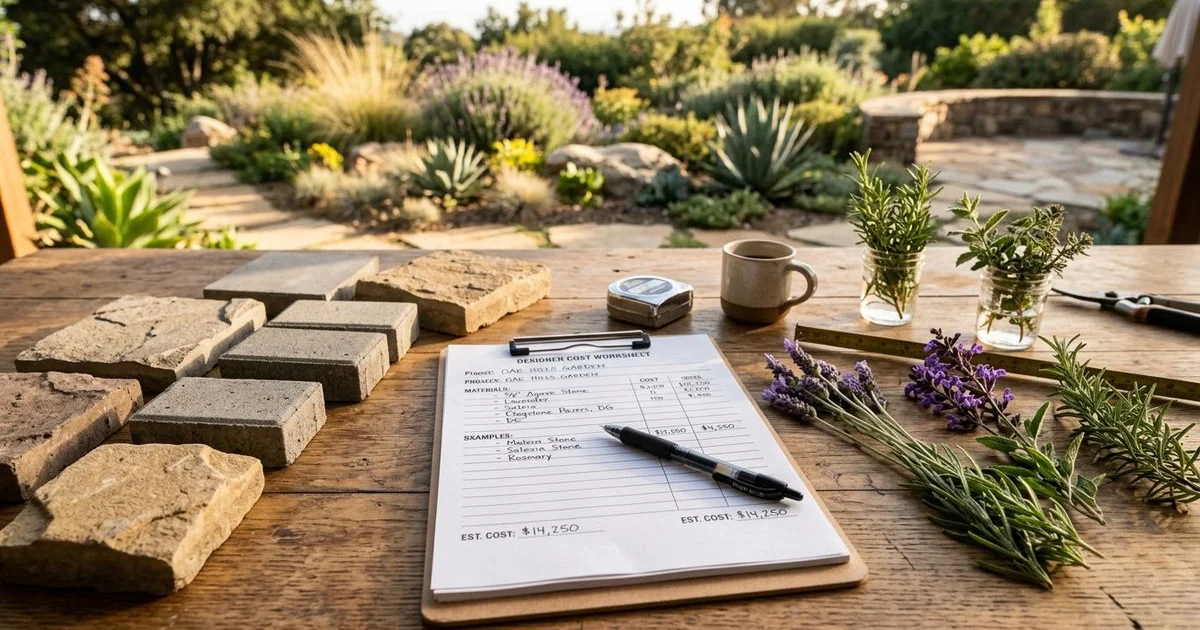
Hillside Landscaping with Native Shrubs and Groundcovers
Hillside properties ask more of a landscape than flat lots do. On a slope, every choice has consequences, from how water moves after irrigation or rain to whether roots help hold soil in place or leave the surface vulnerable to erosion. In the San Gabriel Valley, those decisions matter even more because the hillside character of the region is part of its visual identity, and because drought-tolerant plantings are not just a style preference, they are a practical response to California’s water realities and the demands of hillside terrain.
That is why hillside landscaping with native shrubs and groundcovers has become such a smart direction for many properties. When the plant palette is chosen with the slope, the sun exposure, the soil, and the irrigation system in mind, the result is usually more stable, more resilient, and easier to maintain than a turf-heavy yard that fights the site from day one. The best landscapes do not try to force a hillside to behave like level ground. They work with it.
Reading the slope before planting anything
A common mistake in hillside landscape design is starting with plant shopping instead of site assessment. On a slope, that usually leads to repeated repairs. Water California and related conservation guidance emphasize evaluating irrigation, soil, sun exposure, and plant selection before removing turf or redesigning the planting scheme, and that sequence makes sense in the field. You need to know where water collects, where it runs off too quickly, which parts of the slope bake in afternoon sun, and which areas stay slightly cooler or more protected.
That assessment also helps shape the irrigation plan. Hillsides rarely accept a uniform watering approach. Some sections need slower application so water can soak in rather than sheet off the surface. Other sections, especially where the soil is shallow or compacted, may need careful retrofits to make the system more efficient. If you start with the plants and ignore the water pattern, the landscape often tells you quickly that the plan was backwards.
Microclimate matters too. A hillside in full western exposure behaves differently from a north-facing slope with more shade. Wind, reflected heat from hardscaping, and the slope angle itself all influence plant performance. In drought resistant landscaping, those local conditions are not minor details. They are the blueprint.
Why native shrubs and groundcovers work so well on slopes
Native shrubs and groundcovers bring several advantages to hillside landscaping, and those advantages are especially relevant in California’s dry, fire-conscious environment. The first is obvious: they are generally better matched to local climate patterns than high-water ornamentals. The second is structural. Many native shrubs have root systems that help knit soil together, while spreading groundcovers reduce bare soil exposure and soften the impact of runoff.
There is also a maintenance advantage that homeowners often appreciate after the first season or two. Once established, the right native plants usually need less intervention than a lawn or a bed full of thirsty annuals. That does not mean they are no-care plants. It means the work shifts from constant watering and trimming to thoughtful establishment, occasional shaping, and seasonal cleanup.
In the San Gabriel Valley, plant selection should reflect the regional water-use guidance that encourages climate-appropriate plants and efficient irrigation. The state’s Model Water Efficient Landscape Ordinance also reinforces the direction many property owners are already taking, especially in new construction and renovated landscapes. It pushes the design conversation toward water use, plant suitability, and alternative sources where appropriate, rather than toward decorative planting for its own sake. That framework aligns naturally with hillside landscaping, where the site itself rewards restraint and punishes excess.
The plant palette that earns its place
The best hillside plantings usually rely on a layered mix of shrubs, subshrubs, and groundcovers rather than a single repeated species. That approach gives the slope more texture, more ecological value, and a better chance of handling different exposures across the site. In the San Gabriel Valley, several California natives are especially well suited to this kind of work.
California buckwheat is one of those plants that does a lot of quiet work in the landscape. It fits naturally into dry, sunny spaces and can be used to cover open areas without making them look flat or sterile. California sagebrush brings a lighter, more open texture and reinforces the sense of a hillside that belongs in its setting. Manzanita and ceanothus give structure, seasonal interest, and the kind of woody presence that helps anchor a slope visually. Monkeyflower and foothill penstemon add color without asking for heavy water use, while bunchgrasses are excellent for filling in spaces between shrubs and reducing the amount of exposed soil.
San Gabriel oak is another locally named native species that belongs in the conversation when designing for the region, especially when the goal is to create a landscape that feels rooted in place rather than imported from somewhere else. Used thoughtfully, these plants can create a hillside garden that looks full and intentional while still respecting water limits and slope conditions.
The key is not to use every native available. It is to match the plant to the exact conditions of the slope. A hot upper bank may need a tougher, sun-leaning plant than a lower terrace or a spot that catches a little afternoon shade. That is where landscape design becomes less about appearance alone and more about observation.
Groundcovers are not filler, they are infrastructure
Groundcovers are often treated like a softening layer at the end of a design, but on a hillside they are closer to infrastructure. They help protect the soil surface, slow runoff, and reduce the amount of bare earth exposed to wind and rain. They also help the planting read as finished much earlier, which matters on a slope where open soil can look rough and erodible for too long.
That said, the right groundcover has to be chosen carefully. On a slope, a weak or shallow-rooted groundcover can look good for a season and then thin out, leaving patches of bare soil exactly where you do not want them. In drought tolerant landscaping, density matters. The goal is not only aesthetic coverage but practical coverage. You want a plant that can hold its own, knit into a mass, and cooperate with neighboring shrubs rather than competing them into failure.
Groundcovers also pair well with mulch and small hardscape elements. In many hillside landscapes, a thoughtful combination of planting and hardscaping performs better than planting alone. Small retaining walls, steps, or terraces can break the slope into manageable sections, reduce erosion pressure, and create planting pockets that are easier to irrigate efficiently. That is one of the places where hardscaping supports the landscape rather than overpowering it.
Erosion control, drainage, and runoff deserve equal attention
A hillside planting scheme can be beautiful and still fail if water management is ignored. Erosion control is not a side issue, it is one of the main reasons to choose native shrubs and groundcovers in the first place. When the soil stays exposed, even moderate irrigation or seasonal rain can create runoff that strips topsoil, undermines roots, and leaves channels in the slope.
The goal is to slow water down, not just divert it. That can be done through plant spacing, soil preparation, mulch, and, when needed, carefully integrated hardscaping. Drainage and stormwater runoff should be considered together. If a design sends water into the wrong place, it can damage planting beds, saturate a weak section of slope, or create maintenance headaches that repeat every year.
On some properties, the smartest move is to divide the hillside into zones. Upper areas may need more structural planting and better surface stabilization. Lower areas may be suited to denser groundcovers or plants that can tolerate more accumulated moisture. The point is not to make the slope uniform. The point is to make it work as a system.
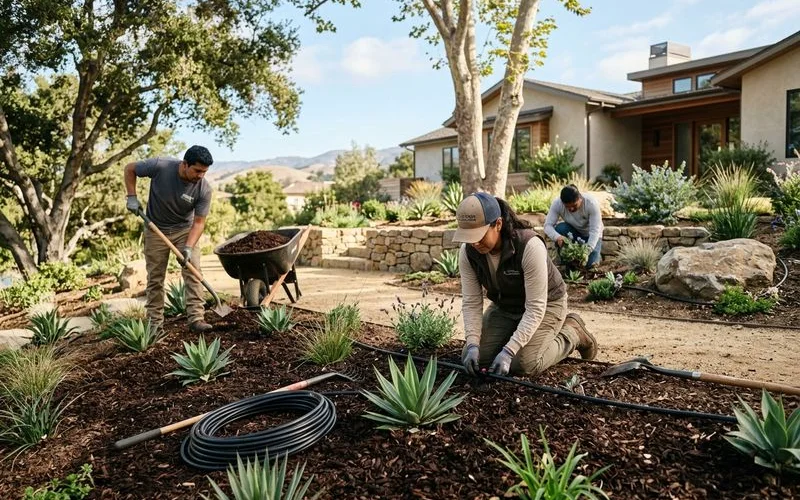
A well-designed hillside often looks calm because the underlying drainage logic is doing its job quietly. When that logic is missing, the landscape may still look fresh for a while, but the first heavy watering or storm event usually exposes the flaw.
Firewise planting belongs in the design, not as an afterthought
In foothill and hillside areas, firewise landscaping is part of responsible planning. The California Native Plant Society has emphasized that slopes need erosion control, drought tolerance, and firewise planting, and that combination is especially relevant in the San Gabriel Valley, where hillside properties sit close to landscapes complete hardscape and landscape services that can be visually beautiful and environmentally sensitive at the same time. Local CNPS guidance for the San Gabriel Mountains region also points to ember-resistant zone rules and the value of using native plants suited to local gardens.
That does not mean a hillside should be stripped bare or reduced to a sterile band of gravel. It means the planting plan should be intentional. Shrubs should be placed with care, and the landscape should be maintained so dead material does not accumulate unnecessarily. The relationship between plant choice and spacing matters. So does the way hardscaping is used around the home and along the slope. If paths, walls, or terraces are part of the design, they should support defensible-space planning rather than create hidden traps for debris.
Firewise work on a hillside often overlaps with drought resistant landscaping in practical ways. Plants that handle lower water and fit the local climate tend to be easier to maintain in a way that keeps fuel loads down. Native landscapes are not automatically fire-safe, but they can be shaped into landscapes that respect local risk and still look like gardens rather than buffer strips.
Turf removal, irrigation retrofits, and the reality of renovation
Many hillside projects begin with turf removal. That is often the right move, especially where lawn is difficult to irrigate evenly or where the slope makes mowing awkward and inefficient. California’s landscape guidance encourages homeowners to think through irrigation, soil, sun exposure, and plant selection before removing turf, because the success of the new landscape depends on what replaces the grass.
Once turf is gone, the irrigation system should not be treated as an afterthought. Retrofit work is often necessary. Hillsides need efficient irrigation that matches the plant zones and the slope geometry. Overwatering is wasteful and can destabilize soil, while under-watering during establishment can cause uneven failure. The first growing season matters most, because that is when roots are trying to settle and the slope is most vulnerable.
It is also worth acknowledging that some turf conversions are more complicated than they sound. A steep bank with poor soil and strong sun may take longer to establish than a gentle incline with better moisture retention. If the site has complicated access, maintenance should be planned realistically. A slope that is beautiful but impossible to reach will become a problem later, no matter how good the plant list looked on paper.
HOA rules and water-efficient landscaping
Homeowners’ associations can create anxiety around landscape changes, especially in areas where front yards are visible and neighborhood character is closely watched. California water guidance is useful here because it makes clear that HOAs cannot prohibit certain water-efficient landscaping choices during drought-related restrictions. That matters for homeowners who want to move toward native shrubs, groundcovers, and lower-water planting without running into unnecessary resistance.
Still, the best results usually come from presenting a landscape that looks deliberate, not temporary. A hillside design that combines native plant masses, clean edges, efficient irrigation, and compatible hardscaping tends to be easier to defend aesthetically than a patchwork of mismatched replacements. If an HOA is worried about appearance, a mature native hillside can often answer that concern better than any policy argument.
What a successful hillside usually looks like after establishment
A successful hillside landscape rarely looks finished on day one. The first year is about establishment, and it can look a little sparse compared with the eventual result. By the second and third seasons, the structure becomes clearer. Shrubs begin to define the slope, groundcovers close in, and the planting starts to read as a living system instead of a collection of individual specimens.
What experienced designers look for is not just visual fullness but stability. Is the soil staying put? Is water moving where it should? Are the plants matching the microclimates on the site? Are a few species carrying the whole slope, or is the planting diverse enough to absorb stress without collapsing? Those questions matter more than a polished first impression.
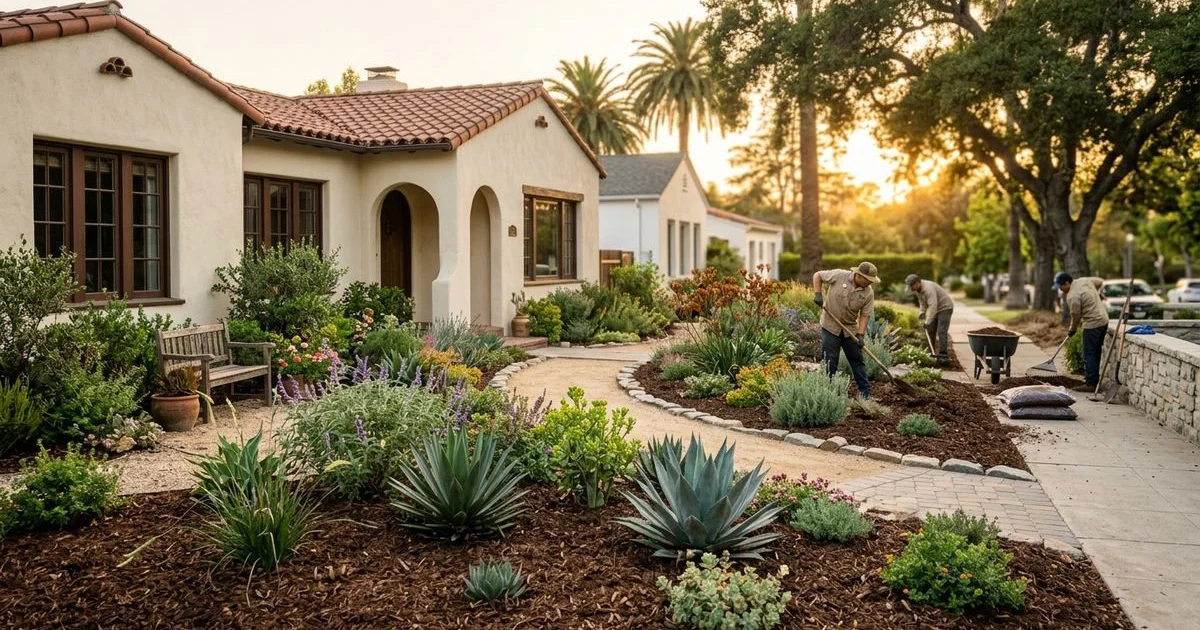
There is also a certain honesty to native hillside planting that clients often come to appreciate. It does not pretend the slope is a flat suburban lawn. It acknowledges the terrain, the climate, and the regional plant community. When done well, the landscape feels as if it could have grown there, even though it was carefully planned.
A practical way to think about the design process
For property owners starting from scratch, the most useful mindset is to treat the hillside as a sequence of decisions rather than a single aesthetic event. First comes the site assessment, then the irrigation strategy, then soil and drainage work, then the plant palette, and finally the details of spacing, hardscaping, and maintenance. Skipping ahead almost always creates problems later.
That sequence is especially important in the San Gabriel Valley, where hillside visual character, water conservation, and firewise concerns all intersect. The region rewards landscapes that are modest in water use, strong in structure, and grounded in native plant communities. California buckwheat, California sagebrush, manzanita, ceanothus, monkeyflower, foothill penstemon, bunchgrasses, and San Gabriel oak are not just attractive options. In the right conditions, they are practical ones.
The most durable hillside landscapes are usually the ones that look like they were designed with restraint. They use plant massing instead of excess ornament. They let hardscaping solve problems that plants cannot solve alone. They respect runoff, sun exposure, and soil limits. And they make room for the reality that a slope is not a blank canvas, it is a living surface that needs to be held, cooled, and watered with care.
When that approach guides the work, hillside landscaping becomes less about fighting the property and more about reading it correctly. That is where native shrubs and groundcovers earn their place, not just as a sustainable choice, but as the right choice for the ground beneath them.