
Hillside Landscaping Tips for Erosion Control and Plant Stability
Hillside properties can be some of the most rewarding landscapes to work on, but they also demand more judgment than a flat yard ever will. A slope changes how water moves, how roots anchor, how sun hits the ground, and how quickly soil can wash away after a hard rain or an overactive sprinkler cycle. In the San Gabriel Valley and throughout foothill communities, that reality is familiar. The visual character of the hills is part of the appeal, yet it also means hillside landscaping has to do more than look polished. It has to hold soil, manage runoff, respect fire risk, and stay healthy through dry stretches.
Good slope design starts with restraint. I have seen too many hillside projects fail because someone treated a slope like a blank canvas instead of a living system. Turf gets stripped without a replacement plan, irrigation is left untouched, and plants are installed for color rather than stability. A year later, the bare spots show erosion, the runoff cuts little channels through mulch, and the few shrubs that survived are fighting poor drainage or reflected heat. The smarter approach blends landscape design, hardscaping, irrigation, and plant selection into one plan. On a hillside, those pieces are inseparable.
Reading the slope before you plant anything
The first mistake people make is rushing to plant. On a hillside, the slope itself tells you what the design needs. Pay attention to where the sun beats hardest, where water pools after irrigation, and where wind dries out the soil fastest. The California water agency’s landscape guidance is clear about the value of assessing irrigation, soil, sun exposure, and plant selection before removing turf. That advice matters even more on a hill, where one part of the property can behave very differently from another.
I have walked slopes that looked uniform from the driveway but turned out to have several microclimates. The upper face was hot and dry by midmorning, the lower section stayed cooler, and a shaded side yard held moisture longer than expected. That kind of variation should shape the planting palette. Drought resistant landscaping is not about using the same tough plant everywhere. It is about matching the plant to the exact conditions it will face, then giving it enough room to establish without being overwatered.
Soil matters as much as sunlight. Loose, disturbed soil erodes faster, especially after grading or construction. If the hillside was recently altered, the top layer may be thin and vulnerable. That is where erosion control has to begin with the ground plane, not the plant list. A well-planned slope may still need temporary stabilization, smart irrigation retrofits, and a clear runoff path before the first shrub goes in.
Erosion control is a design problem, not just a maintenance problem
Erosion on a slope usually starts small. A trickle of water follows a footpath, irrigation overshoots the planting bed, or mulch slides downhill after the first storm. Those small movements become channels if the surface is left exposed. Once that happens, roots have a harder time gaining purchase, and the slope becomes more difficult to repair.
Hardscaping can help here when it is used thoughtfully. Retaining elements, step paths, terrace transitions, and well-placed edging can slow water and break long runs of exposed soil. The goal is not to cover every hillside with stone or concrete. That would defeat the purpose of a living landscape and can make drainage problems worse if the project is handled carelessly. Instead, hardscaping should interrupt runoff, support access, and create safer planting zones. In hillside landscaping, even a modest change in grade treatment can reduce erosion pressure significantly because it shortens the distance water can travel before it loses speed.
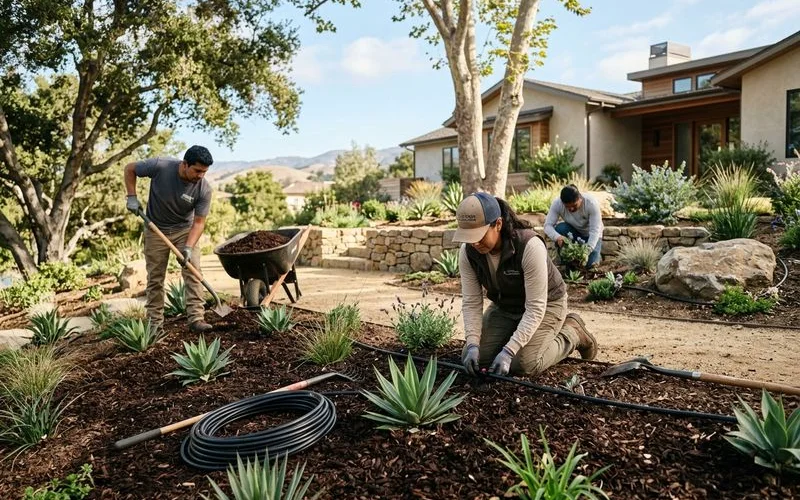
Mulch still has a role, but it should be used with discipline. On a steep incline, loose mulch can migrate downhill if it is applied too heavily or without enough plant cover to hold it in place. I prefer to think of mulch as a temporary buffer while roots take over. The long-term answer is vegetation with enough density and structure to anchor the soil.
That is one reason native and climate-appropriate plants are so valuable. They are not just water-wise. Many are adapted to local slopes, summer dryness, and the sort of thin soils that show up on hillsides. In the San Gabriel Valley, that can mean plants such as California buckwheat, California sagebrush, manzanita, ceanothus, monkeyflower, foothill penstemon, and bunchgrasses. These are not interchangeable, and they should not be treated as if any hillside can hold anything native. But in the right microclimate, they do exactly what hillside plants need to do. They cover soil, tolerate heat, and establish root systems that contribute to stability over time.
Plant stability depends on roots, spacing, and patience
When people talk about plant stability on a hillside, they often focus on size. They want something that looks full quickly. I understand that instinct. Bare slopes are unnerving. But on an incline, aggressive top growth can be deceptive. A plant can look lush while still failing to develop the root mass needed to secure itself in wind, heat, or shifting soil.
Spacing matters more on slopes than in flat gardens. Crowd plants too tightly, and you may trap too much moisture around crowns or create competition that weakens root development. Space them too far apart, and the slope remains exposed long enough for erosion to continue. The right spacing depends on plant form, soil type, and slope angle, which is why a one-size-fits-all planting plan rarely works. A hillside landscape design should think in terms of coverage over time, not just instant visual fill.
This is where drought resistant landscaping often gets misunderstood. People assume drought-tolerant plants need little attention at all. In reality, they need the right kind of attention during establishment. Deep, infrequent watering usually serves hillside plants better than shallow, frequent irrigation, because it encourages roots to move downward rather than stay near the surface. Shallow rooting is a liability on slopes. It leaves plants more vulnerable to heat, runoff, and instability.
The irrigation system must support that rooting pattern. Drip is often a better starting point than overhead spray on a hillside because it delivers water where it is needed and reduces runoff. Yet even drip can fail if the emitters are placed poorly or the schedule is too aggressive. Water should be applied slowly enough for the soil to absorb it. If water moves downslope before it soaks in, the schedule is wrong, the soil texture is limiting, or the emitter placement needs revision. Those are design problems, not planting failures.
Native plants work hard, but only when they fit the site
California native plants are often the backbone of successful hillside landscaping, especially in regions where water conservation is a serious concern. They also align well with the state’s Model Water Efficient Landscape Ordinance, which encourages native and climate-appropriate plants, efficient irrigation, and alternative water sources in new and renovated landscapes. That matters for hillside projects because water use, slope stability, and plant selection all pull in the same direction when the design is done well.
Still, native does not automatically mean easy. A plant that thrives in one exposure may struggle in another. A shrub suited to an open, sunny slope may decline in a pocket of shade or in heavier soil near a drain line. A good designer pays attention to the specific site rather than relying on the word native as a shortcut.
In the San Gabriel Mountains and surrounding foothill landscapes, the plant palette should also respect the area’s ecology and firewise needs. CNPS notes that slopes need erosion control, drought tolerance, and firewise planting, which is exactly the combination hillside properties demand. That means choosing plants with sensible growth habits, avoiding dense fuel buildup near structures, and thinking carefully about how plant groupings affect both maintenance and access.
San Gabriel oak is one locally named native species that fits the broader conversation about habitat, structure, and regional identity. It is not the right choice for every yard, but it reminds us that hillside landscaping can support more than ornamental value. It can connect a property to the landscape it sits in, which is important in a region where the San Gabriel Mountains support many rare, threatened, and endangered species.
Firewise planning and hillside planting belong together
Hillsides do not only erode, they burn. That fact changes how landscape design should be approached. Fire-resistant planting does not mean a landscape is fireproof, and it certainly does not mean eliminating all plant material. It means choosing plants and arranging them so the landscape is less likely to carry fire quickly or create avoidable fuel near the house.
In practical terms, that means looking at the structure of the planting near the home, along access routes, and on steeper upper slopes where maintenance can be harder. It also means avoiding cluttered plant massing that traps dry debris. I have seen beautiful slopes that became maintenance headaches because the plants were chosen for fullness rather than manageability. A plant that looks graceful in the first year can become a dense thicket by year five if no one accounted for its mature form.
Firewise landscaping in hillside settings should work with irrigation and drainage, not against them. Overwatering can create weak, lush growth that needs more pruning. Underwatering can stress plants so badly that they shed more litter or fail to establish. The middle ground is to choose species suited to the site, water efficiently during establishment, and then taper back as roots take hold.
Why turf removal should be planned, not rushed
Turf removal is often discussed as a water-saving move, and it can be, but on a slope it needs careful handling. Removing grass from a hillside without replacing it with a stable planting plan is a fast way to expose soil. The California guidance on landscape conversion is useful here because it emphasizes assessing irrigation, soil, sun exposure, and plant selection before turf comes out. That sequence matters. Once the turf is gone, the slope is more vulnerable than before.
I have seen projects where turf was removed in summer, irrigation was not redesigned, and the hillside sat bare for months while homeowners tried to decide what to plant. During that time, wind and water had all the advantage. A better approach is to stage the work. Prepare the irrigation first, install the plants with proper spacing, and use temporary erosion control where needed so the slope is never left naked for long.
Turf-free does not mean plant-free. It means the new landscape should be built around woody shrubs, groundcovers, bunchgrasses, and hardscaping elements that help shape water movement. When a slope is managed this way, the landscape often looks more intentional and far more resilient than a patchy lawn ever did.
Water-wise design is not a trend in the San Gabriel Valley, it is a necessity
The San Gabriel Valley has its own landscape identity, and hillside properties are a major part of that visual character. New construction and renovated landscapes in the region increasingly need to balance appearance, water efficiency, and slope performance. That is not a marketing slogan. It is a practical response to local conditions.
Water-efficient landscape planning starts with the basics. Know what the soil can absorb. Know where the sun strikes hardest. Know how much water each area truly needs. Then select plants that can live within those limits without constant correction. The state’s water guidance and the WUCOLS framework both point toward that kind of planning. They are useful because they keep homeowners and designers from guessing.
In many projects, the most successful designs are not the most elaborate. They are the ones that quietly solve multiple problems at once. A properly graded terrace can slow runoff and create room for a mixed planting bed. A narrow hardscaping path can give access for maintenance without trampling roots. A drip system can keep establishment water targeted. A combination of native shrubs and bunchgrasses can stabilize the soil and reduce the need for constant irrigation. Good landscape design on a slope is rarely flashy up close, but it performs well over time.
HOA restrictions and homeowner concerns
Homeowners in managed communities sometimes worry that water-wise changes will run into HOA rules. California water restriction guidance has made clear complete hardscape and landscape services that homeowners’ associations cannot prohibit certain water-efficient landscaping choices during drought-related restrictions. That does not erase every community standard, but it does matter. It gives property owners room to make sensible choices about drought-tolerant landscaping, irrigation retrofits, and landscape conversion without treating common rules as absolute barriers.
That said, I would still advise anyone in an HOA community to review design guidelines early. It is far easier to choose materials and plant palettes that satisfy both the association and the site than to argue about them after installation. A well-prepared hillside project can usually meet aesthetic expectations while still supporting erosion control and water conservation.
What tends to fail, and what usually lasts
The failures I see most often are not dramatic. They are incremental. A slope is overwatered for the first six months. The soil shifts a little. A few plants die and are not replaced. Bare patches widen. Someone adds more mulch, which slides. Then the slope starts to look tired long before it should.
The projects that last are usually the ones where the homeowner or designer accepted that hillside landscaping is a sequence, not a single installation day. The soil is read first. Irrigation is adjusted before planting. Plants are selected for microclimate, not just appearance. Hardscaping is used to interrupt runoff and support access. Native and drought-tolerant plants are placed where they can actually thrive. Firewise considerations are part of the layout from the beginning, not an afterthought.
That kind of work requires patience, but it pays off. A stable hillside has a certain calm to it. Water moves where it should. Plants hold their shape without constant intervention. The slope looks lived in, not forced. That is the mark of good hillside landscaping, and it is especially important in regions where erosion, drought, and fire risk all share the same ground.
The best slope designs do not fight the hill. They learn it, then work with it.