
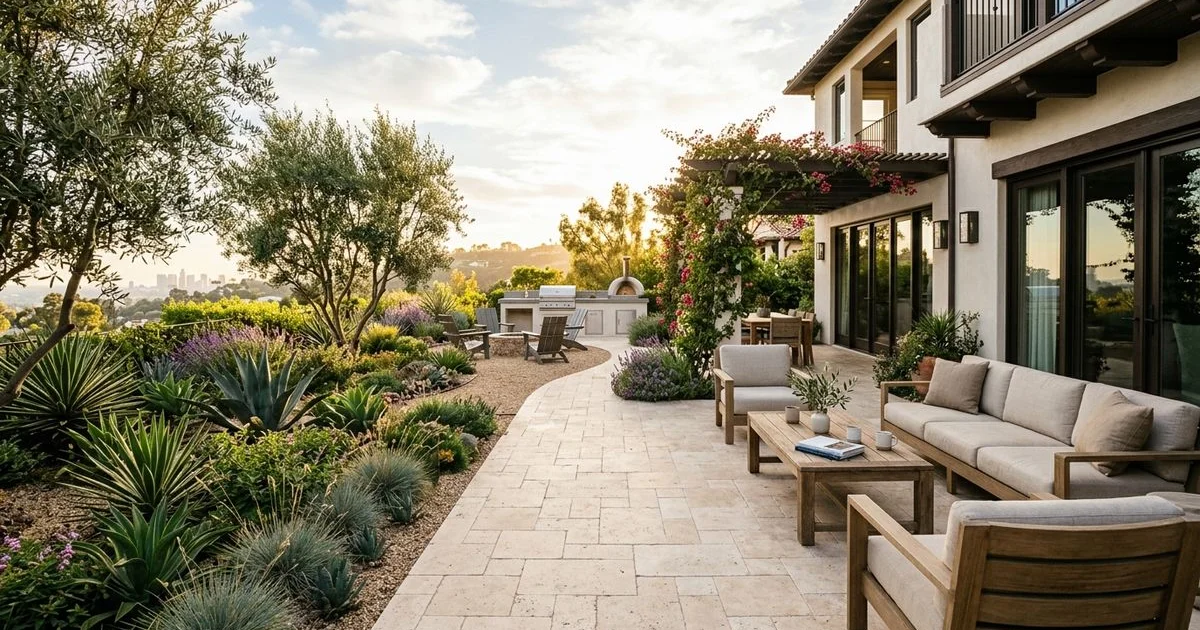
Drought-Tolerant Front Yard Landscaping Made Simple
A front yard in the San Gabriel Valley has to do more than look tidy. It has to deal with bright sun, long dry stretches, occasional runoff, and in many neighborhoods, the visual pressure of a hillside or foothill setting. That combination pushes the design conversation away from thirsty lawn and toward something more durable. Drought-tolerant front yard landscaping is not just a style choice here, it is a practical response to climate, terrain, and water-use expectations that are shaping new and renovated landscapes across California.
The good news is that a water-wise front yard does not need to look sparse or severe. When it is planned well, it can feel layered, welcoming, and local to the region. It can also be easier to maintain than a conventional lawn-heavy yard, especially once the plant palette, irrigation, and hardscaping work together instead of fighting one another. The projects that succeed most often are the ones that start with the site, not with a shopping cart full of plants.
Start with the site, not with the plant list
The most common mistake I see is people beginning with plant names. They fall in love with a species they saw somewhere else, then try to squeeze it into a front yard with the wrong sun exposure, poor drainage, or too much reflected heat from pavement. The plant survives for a while, then declines, and the yard starts to look tired much sooner than expected.
A better starting point is to assess how the yard actually behaves through the day. Notice which areas get full sun, which get morning light and afternoon shade, and which zones stay hotter because they sit near a driveway, wall, or south-facing facade. Look at slope, too. A hillside front yard in the San Gabriel Valley has different needs than a flat lot in a sheltered neighborhood. Slopes shed water quickly, which means irrigation, soil cover, and erosion control all matter more. California guidance on water-wise landscaping puts this same logic at the front of the process, because soil, sun exposure, irrigation, and plant selection all work together.
That assessment saves money later. If a shady corner only needs occasional watering, there is no reason to install a plant group built for full sun and frequent irrigation. If the front yard has compacted soil, fixing the soil structure or changing the planting approach may be more valuable than adding more expensive plants. The most successful drought resistant landscaping is usually the one that respects the site instead of trying to overwrite it.
Why front yards in this region need a different approach
The San Gabriel Valley has a landscape character that is closely tied to its foothills and mountains. That visual context matters. A front yard here should not feel like a transplanted East Coast lawn scene dropped into a dry climate. It should feel like it belongs to the place. That means using water-efficient landscapes, climate-appropriate plants, and design choices that hold up under heat and seasonal dryness.
California’s Model Water Efficient Landscape Ordinance also matters here because it shapes how new and renovated landscapes think about water use. The larger direction is clear: reduce waste, use efficient irrigation, and favor plants that suit the climate. That does not mean every front yard must become a native plant garden, but it does mean the old assumption that a broad turf lawn is the default no longer holds up well.
For homeowners, this shift can actually simplify decision-making. Instead of trying to keep a high-water landscape alive with constant inputs, you can build a front yard that is more stable over time. That often translates into lower irrigation demand, fewer problem areas, and a cleaner look through dry periods when traditional lawns start to brown unevenly or need far more attention than they are worth.
The case for a smaller lawn, or no lawn at all
Front yards are often where turf is least functional. They are exposed, visible, and frequently shaped by driveways, walkways, slopes, and utility elements. A lawn in that setting may look appealing on paper, but in practice it can become a high-maintenance patch that consumes water and still struggles in heat. In many San Gabriel Valley properties, the better question is not how to save the lawn, but whether the lawn is actually needed.
Reducing turf area can open up room for structure and plant diversity. It can also make irrigation easier, because the landscape can be divided into zones based on plant water needs. Water CA’s landscape guidance points homeowners toward this kind of planning, including an honest look at irrigation efficiency and plant selection before turf removal. That sequence matters. A lawn replacement project is most successful when the replacement design is ready before the first strip of turf comes out.
In some yards, a very small lawn still makes sense, especially if the property needs an open visual plane near the street or a place for occasional use. In other yards, a gravel, mulch, or hardscape forecourt does the job better. The right answer depends on how the space is used and how much water the owner wants to commit to it year after year.
Hardscaping does the heavy lifting
Hardscaping is one of the smartest tools in drought-tolerant front yard landscaping because it solves more than one problem at once. Paths, retaining edges, seat walls, steps, boulder accents, and permeable surfaces can organize the yard, control movement, and reduce the amount of planted area that needs irrigation.
On a flat property, hardscaping can create definition where turf once did all the visual work. On a hillside, it can stabilize circulation and reduce the sense that the yard is sliding downhill in layers of loose material. Well-planned hardscaping also helps with stormwater runoff by directing water where it belongs instead of letting it race across the surface. That is especially useful in front yards where grades, curb cuts, and driveway slopes can create messy runoff patterns during storm events.
The key is restraint. Too much hardscape can make a front yard feel hot and overbuilt, especially if large surfaces reflect heat back toward the house. Materials should be chosen with the climate in mind, and the layout should leave enough planted space to soften the edges. A front yard works best when the hardscape gives structure and the plants provide texture, movement, and seasonal change.
Plant selection should follow microclimate, not fashion
In drought resistant landscaping, plant choice is less about novelty and more about fit. A plant that thrives in one part of the yard may struggle ten feet away if the soil is thinner, the sun is stronger, or runoff is more intense. That is why microclimate matters so much.
For the San Gabriel Valley, California native plants and other climate-appropriate species make a strong foundation. Plants commonly associated with local water-wise and native gardens include California buckwheat, California sagebrush, manzanita, ceanothus, monkeyflower, foothill penstemon, and bunchgrasses. San Gabriel oak is also a locally named native species that fits the regional story. These plants are attractive because they are not forcing a fight with the climate. They are already adapted to conditions that resemble the challenges a front yard will face.
That said, native does not automatically mean easy. Some natives need room to mature, and some dislike overhead irrigation once established. Others are better on a slope than in a low basin. Ceanothus, for example, can create a beautiful mass in the right setting, but it needs proper siting and room to breathe. Manzanita gives structure and year-round interest, but it should not be buried in rich, water-holding soil. Bunchgrasses can be the quiet backbone of a design, especially when the goal is to make the yard feel natural without becoming wild.
The plant palette should also reflect sun exposure and soil behavior. A hot south-facing strip near paving may need tougher selections than a partially shaded entry area. That sort of judgment is where professional landscape design pays off. The right plants are not the most fashionable ones. They are the ones that stay healthy without demanding constant rescue.
Slopes need more than good intentions
Hillside landscaping deserves special attention because slopes are where dry planting failures become obvious quickly. Water runs downhill, soil moves with it, and roots have less margin for error if the planting plan ignores erosion control. In the San Gabriel Valley and the foothill areas nearby, this is not a minor detail. It is part of the landscape.
On slopes, groundcover, deep-rooted shrubs, and careful irrigation layout matter as much as visual composition. A hillside should not be left to depend on isolated shrubs surrounded by bare soil. Bare soil invites erosion and looks unfinished. It also warms up fast and loses moisture quickly. A layered slope planting, with plants that can help hold the soil and cover the grade, does much more useful work.
Firewise thinking is relevant here too. The California Native Plant Society notes the importance of drought tolerance, erosion control, and firewise planting on hot, sunny slopes. That premium landscape construction combination makes sense for local hillside conditions. A slope planting should be practical first, attractive second, and ambitious only where the site can support it. The best hillside front yards often look calm from the street because the engineering and planting underneath are doing quiet, careful work.
Irrigation should be part of the design, not an afterthought
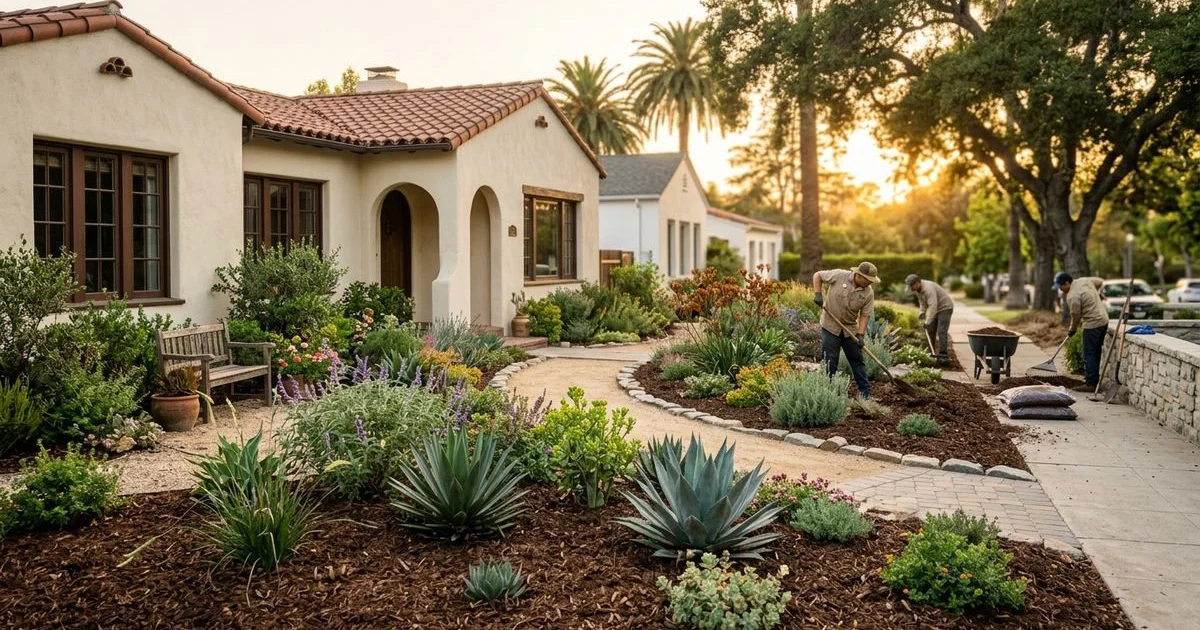
A surprising number of landscape problems begin with the irrigation system. Old spray heads that wet the sidewalk, mismatched watering zones, and overwatered plant beds can undo otherwise good design. If the front yard is being renovated, irrigation retrofits should be part of the plan from the start.
Efficient irrigation is one of the simplest ways to support a water-wise landscape. Different plant groups often need different watering schedules, so separating them into appropriate zones helps prevent the usual cycle of overwatering one area to save another. Native and climate-appropriate plants generally do better with less frequent irrigation once established, but they still need a thoughtful establishment period. That transition matters. A new drought-tolerant planting is not the same as a mature one.
Runoff also needs attention. If water is escaping into the street or pooling where it should not, the system is wasting water and potentially creating maintenance issues. A well-planned front yard should send water where roots can use it. In some cases that means adjusting emitter placement. In others, it means changing the shape of the planting bed or the grade of a walkway edge so water moves more predictably.
Firewise and water-wise can work together
People sometimes act as if fire-resistant planting and drought-tolerant landscaping are competing goals. In practice, they often overlap. The same design habits that reduce water use can also support defensible-space thinking: keeping plants appropriately spaced, reducing excess fuel near structures, and avoiding dense, unmanaged masses right up against the house.
In the San Gabriel Mountains region, firewise considerations are especially relevant. Ember-resistant zone planning and appropriate plant selection are part of the larger landscape conversation here. That does not mean a front yard has to be stripped bare. It means the planting should be intentional. A clean hardscape edge near the house, thoughtful plant spacing, and well-maintained materials can all contribute to a safer-feeling front yard without making it sterile.
This is where good landscape design earns its keep. A front yard can be both attractive and disciplined. It can use shape, texture, and repetition to create beauty without relying on water-heavy planting. That kind of restraint often reads as more elegant than a yard packed with unrelated plants.
HOA rules do not erase water-wise choices
For many homeowners, the final obstacle is not the design itself but the neighborhood rulebook. HOA expectations can make people nervous about removing turf or changing the look of the front yard. California water restriction guidance makes an important point here, homeowners’ associations cannot prohibit certain water-efficient landscaping choices during drought-related restrictions.
That does not mean every HOA will be easy. It does mean homeowners have more room than they sometimes think to pursue drought-tolerant front yard landscaping. The most effective way to approach this is with a clear plan, a design that looks finished on day one, and a planting palette that appears intentional rather than temporary. An HOA is more likely to respond well to a front yard that looks coordinated, maintained, and regionally appropriate than to a half-finished lawn removal project.
A simple plan can help ease that conversation. A front yard that uses hardscaping to define the space, a limited but coherent plant palette, and clean edging often signals care immediately. That matters when the neighborhood values appearance but the homeowner wants to reduce water use.
A simple way to think about the whole project
If the process feels overwhelming, it helps to reduce it to a few practical decisions. First, understand the site. Second, decide how much lawn, if any, actually serves a purpose. Third, use hardscaping to shape the yard and manage movement. Fourth, choose plants that fit the sun, soil, and slope. Fifth, install irrigation that matches the new layout instead of trying to force the old system to work.
That sequence keeps the project grounded. It also prevents the common trap of overcomplicating the front yard with too many species, too many materials, or too many competing ideas. Some of the most successful drought-tolerant front yards in this region are not elaborate. They are disciplined. They repeat a few strong plants, use a measured amount of stone or paving, and leave enough space for the composition to breathe.
A front yard built this way tends to age well. The plants settle in. The irrigation becomes predictable. The hardscaping gives the property structure. And the whole space starts to look like it belongs in the San Gabriel Valley rather than fighting the climate that defines it.
What a finished yard should feel like
A well-designed drought-tolerant front yard should feel calm from the curb and practical up close. It should offer enough variation to keep it from looking flat, but not so much that it becomes noisy. It should use water efficiently without looking defensive about it. It should handle heat, slope, and runoff with a degree of confidence.
That is the real promise of drought-tolerant front yard landscaping. It is not about sacrifice. It is about choosing a design that matches the place, uses resources more carefully, and improves with time instead of becoming more fragile. In the San Gabriel Valley, where hillside character, water conservation, and native habitat all intersect, that kind of landscape feels especially at home.
A front yard can be simple and still feel complete. It can use hardscaping for structure, native and climate-appropriate plants for texture, and smart irrigation for reliability. It can support erosion control, respect firewise principles, and meet the practical realities of water-conscious landscaping. Most importantly, it can make the house look settled into its surroundings, which is the mark of a front yard that was designed with care rather than copied from a generic plan.