
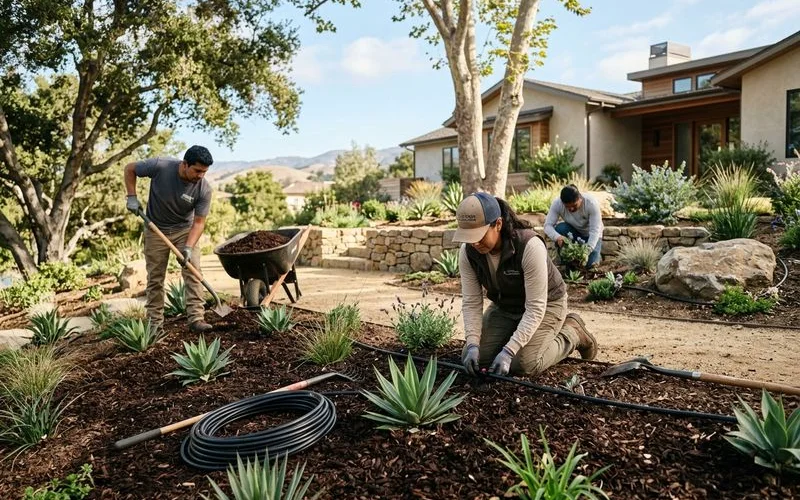
Hardscape and Plant Balance in Water-Conscious Landscape Design
A water-conscious landscape succeeds when every square foot has a job to do. That sounds simple, but the real work sits in the balance between built surfaces and living plant material. Hardscape gives a yard structure, circulation, and durability. Plants soften the edges, cool the space, slow water, and make the whole composition feel rooted to the site. When those two elements are pulled out of balance, the result is easy to spot. Too much hardscape and the yard becomes hot, reflective, and mechanically expensive to maintain. Too much planting without structure and the space can feel loose, difficult to use, and prone to runoff or erosion.
In places like the San Gabriel Valley, that balance matters even more. The region’s hillside character, seasonal dryness, and pressure to conserve water push landscape design away from decorative excess and toward a more disciplined approach. The best projects I’ve seen in this context are not the ones with the most features. They are the ones that understand soil, slope, sun, irrigation, and plant selection before a single paver is set or a tree is planted. That order of operations is what keeps a landscape attractive after the first season, not just on installation day.
Hardscape as structure, not filler
Hardscaping often gets treated as the visual anchor of a design, but in a water-conscious landscape it should be more than that. It needs to support how the site drains, how people move through it, and how much heat the yard retains. A patio, retaining wall, permeable path, or seat wall can make a property far more usable, especially on a slope or a narrow lot. The mistake is to let hardscape dominate simply because it is easier to draw on paper than plant communities are to establish in real soil.
The most successful hardscape is usually modest, purposeful, and tied to the grade. On hillside landscaping, that can mean terracing that reduces erosion and creates flatter planting pockets instead of asking a slope to behave like a level yard. It can mean stepping stones through a planting bed rather than broad, uninterrupted paving that sheds water too quickly. It can also mean using walls or edges to define the garden without making the landscape feel sealed off from the surrounding setting. In dry climates, hardscape should guide water, not repel it in a way that sends runoff downhill and out of the yard.
Heat is another factor people underestimate. Light-colored paving, open joints, and shaded surfaces can help, but the most effective cooling strategy is still plant cover. A patio bordered by drought-tolerant shrubs and a few well-placed trees feels markedly different from one surrounded by bare masonry. The plants do not have to be lush in a tropical sense to change the microclimate. Even modest canopy and layered shrubs reduce glare, soften wind, and make hardscape usable for more of the day.
The plant side of the equation
Water-conscious landscape design begins with plant selection, but not in the decorative sense. The starting point is function. California’s water guidance points designers and homeowners toward evaluating irrigation, soil, sun exposure, and plant needs before removing turf. That sequence matters because the plant palette should fit the actual conditions of the site, not an idealized version of it. A sunny, fast-draining slope calls for a different approach than a shaded, sheltered courtyard. A front yard with reflective pavement and strong afternoon sun behaves differently from a back garden with filtered light and deeper soil.
This is where drought resistant landscaping is often oversimplified. People think it means fewer plants or a gravel-heavy yard. In practice, it means using plants that fit the climate and the microclimate, then arranging them so they can establish and persist with less supplemental water. Native and climate-appropriate plants usually perform well in that role because they are adapted to local conditions and seasonal rainfall patterns. The California Water Efficient Landscape framework reinforces that direction by encouraging efficient irrigation, alternative water sources where appropriate, and plant choices that reduce unnecessary demand.
The plant layer also does work that hardscape cannot. It stabilizes soil, especially on slopes. It interrupts the force of water moving downhill. It creates habitat and visual variety. It gives the space a sense of time, because plants change across seasons in ways paving never does. In the San Gabriel Valley, where the surrounding hills give the region such a distinct visual identity, planting that echoes the local ecology often feels more natural than trying to force a highly ornamental look onto a site that wants something more restrained.
What balance looks like on the ground
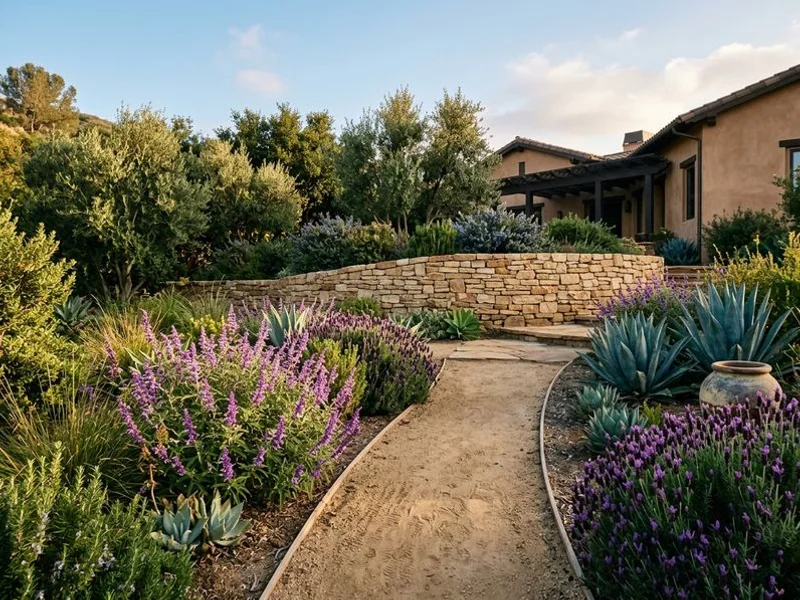
The idea of balance becomes clearer when translated into design decisions. A good project usually meets several of these conditions at once, even if they are handled quietly rather than as a grand gesture.
- Hardscape is sized for actual use, not leftover space.
- Planting beds are placed to catch, slow, and absorb water where possible.
- Slopes are stabilized with plants and grade changes instead of left bare.
- Irrigation is matched to plant zones and microclimates.
- The planting palette reflects local conditions rather than generic “low-water” labeling.
That last point deserves emphasis. Not every plant sold as drought tolerant is right for every part of the yard. Water needs shift with sun exposure, wind, soil depth, and whether a plant is sitting near a heat-reflective wall. A plant can be perfectly appropriate in one corner and struggle in another. Good landscape design respects those differences instead of flattening the site into one irrigation schedule.
Hillside landscaping asks for restraint and precision
Hillside landscaping changes the rules. On flat ground, a landscape can sometimes absorb design mistakes and still function reasonably well. On a slope, small errors become obvious. Water moves faster. Soil exposes more readily. Plants dry out unevenly. Gravity is always working against poor planning.
For sloped sites in the San Gabriel Valley, erosion control is not a secondary concern. It is the foundation of the whole project. Planting choices need to support the slope, and the hardscape needs to break the site into manageable pieces. That may mean using drought-tolerant groundcover, shrubs, and small trees in combinations that knit the soil together. It may mean reducing exposed bare earth and avoiding large expanses of unbroken paving that collect heat and push runoff downslope. It also means thinking about maintenance access. A hillside planting that looks elegant on day one but cannot be watered, trimmed, or inspected safely is not a good design.
I’ve seen steep sites transformed by a simple shift in approach. Instead of fighting the slope with a broad terrace and oversized retaining walls, the design used a series of smaller changes in grade, with planting pockets that held the soil and gave the eye places to rest. The result was calmer, safer, and easier to maintain. It also felt more like the surrounding hillside character, which matters in an area where the landscape context is part of the property’s identity.
Firewise planting belongs in the conversation
Water-conscious design and firewise planning often overlap more than people expect. In foothill and hillside areas, especially near the San Gabriel Mountains, the plant palette has to do double duty. It should conserve water, but it should also support defensible-space goals and avoid creating dense, highly flammable conditions near the home. That does not mean the landscape has to be stripped bare. It means the composition needs to be thoughtful, with spacing, maintenance, and plant selection working together.
Native plants can play a central role here when they are used with judgment. Many California natives are well suited to dry conditions and can fit into fire-conscious landscapes when placed correctly. California buckwheat, California sagebrush, manzanita, ceanothus, monkeyflower, foothill penstemon, bunchgrasses, and San Gabriel oak are all examples of plants that naturally fit the region and can contribute to a landscape that feels local rather than imported. The key is not to treat them as interchangeable ornaments. They differ in size, form, and maintenance needs, and they need room to perform.
Firewise design also puts pressure on the built portions of the landscape to be disciplined. A patio or path can help separate planting zones near structures. Beds close to the home may need simpler plant masses and cleaner maintenance. The goal is not a sterile yard. It is a landscape that still reads as planted and alive, while supporting ember-resistant zone principles and practical defensible-space planning.
Turf removal is not the goal, the right replacement is
Turf removal gets a lot of attention because it is visible and measurable. But removing grass without a plan is just demolition. The real question is what replaces it. California’s water guidance emphasizes evaluating irrigation, soil, sun, and plant needs before removing turf, which is exactly the right order. If the lawn is coming out, the replacement needs to solve a set of problems at once: water use, heat, drainage, usability, and visual coherence.
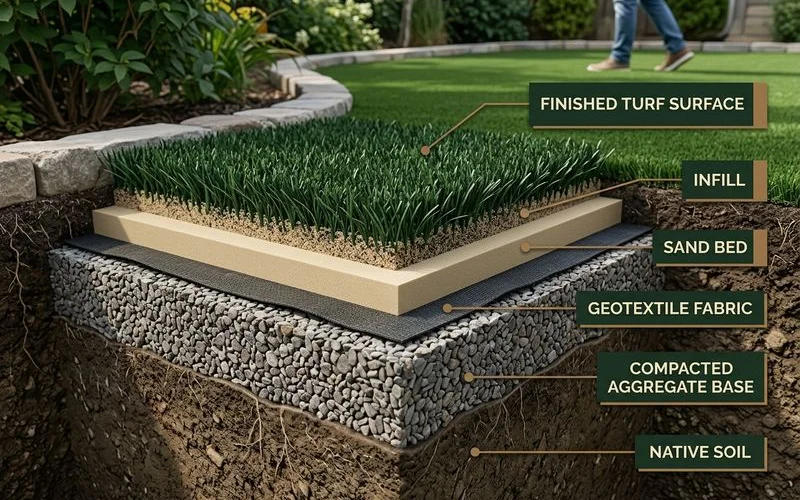
A former lawn can become a combination of planting beds, decomposed granite or paving for circulation, and low-water plant masses that create structure. Sometimes the right answer is not a carpet of plants but a simpler field with islands of shrubs, accent trees, and groundcover where the soil and irrigation can support them. In other cases, the site may benefit from a small remaining lawn area, especially where children, pets, or active use make that practical. Water-conscious design does not require eliminating every soft surface. It requires making each zone intentional.
The most common failure after turf removal is creating a yard that looks finished in the abstract but performs poorly in practice. Bare soil heats up, weeds move in, and irrigation never quite matches the needs of the scattered plants. A stronger approach gives the space a rhythm. Hardscape defines movement. Plants define the microclimate. Mulch or other soil protection keeps the surface from baking while the planting matures. Nothing has to be overbuilt, but everything needs a reason to be there.
Irrigation is part of the design, not an afterthought
Too many landscapes are planted first and watered later, which is backwards. Efficient irrigation has to be designed around the plant palette and the site conditions. The California water guidance is clear on this point, and in practice it means grouping plants by water need, sun exposure, and soil behavior. A sprinkler zone that waters a dry-slope native shrub the same way it waters a more thirsty planting is rarely efficient for long.
Drip irrigation is often a good fit for planted beds because it delivers water more directly to roots and reduces unnecessary wetting of hard surfaces. But even drip is only as good as the layout and the plant grouping. On a hillside, pressure differences and runoff can complicate watering patterns. On a hot, exposed site, plants near walls or pavement may dry out faster than plants in shaded pockets. The system should reflect those realities rather than assume even conditions across the yard.
Irrigation retrofits also matter when the landscape is being updated in phases. A property does not have to be redesigned all at once to improve its water performance. Sometimes the most practical path is to correct the irrigation first, then remove turf, then adjust planting beds as the budget and the site allow. That is often a more realistic route for homeowners who want lasting improvement without tearing the whole property apart.
HOA rules do not erase water-efficient choices
Homeowners’ associations can shape how a landscape looks, but they do not have unlimited authority over water-efficient choices during drought-related restrictions. That matters in communities where the visual standard has historically favored uniform turf or highly manicured planting. The landscape conversation in California has shifted toward efficiency, and the rules reflect that. For homeowners, it means drought-tolerant landscaping is not a fringe preference. It is an increasingly normal response to local conditions and policy.
That said, compliance and design are not the same thing. A landscape that merely satisfies a rule can still be poor. A much better result comes when the property owner, designer, or contractor uses the constraint as a design brief. If turf is being reduced, what form should replace it? If the slope needs erosion control, what can do that while still looking intentional? If the front yard is visible from the street, how can hardscape and planting work together to preserve the neighborhood’s character without wasting water?
The design process rewards site-specific thinking
The best water-conscious landscapes start with a careful reading of the site. Soil type, sun exposure, slope, existing drainage, fire risk, and irrigation capacity all affect the final design. So does the visual role of the property in the neighborhood. In the San Gabriel Valley, many landscapes are seen from the street, from uphill, or against a foothill backdrop. That means a successful design has to hold up visually at multiple scales. It needs to read well from a distance and still work up close.
That is one reason native habitat gardening can be so effective in this region. It gives the landscape a clear identity without demanding high water use. It also connects the property to the larger ecological story of the San Gabriel Mountains, a region known for its habitat value paver patio specialists and plant diversity. A well-composed planting can nod to that setting without trying to mimic it too literally. The result is more maintainable and usually more graceful than an arrangement built from unrelated ornamental pieces.
The practical side of the work should not be romanticized. Plants die when they are put in the wrong place. Pavers shift when drainage is ignored. Slopes erode when the soil is left open. Irrigation fails when zones do not match plant needs. Good design is partly aesthetic judgment, but it is also discipline. It asks what the site needs before asking what looks nice on the sketch.
A workable plant palette and how to use it
A strong regional palette does not need to be large to be effective. In fact, too many species can make maintenance harder and weaken the visual unity of the project. A compact palette, used in repeats and arranged by exposure, often performs better.
California buckwheat can provide structure and seasonal presence. California sagebrush brings a loose, native texture that works well in larger planting masses. Manzanita offers form and year-round presence. Ceanothus can add a stronger architectural note where conditions suit it. Monkeyflower and foothill penstemon bring color without asking the landscape to behave like a high-water garden. Bunchgrasses help stitch areas together, especially where a softer transition is needed between hardscape and larger planting zones.
Used well, those plants can define different parts of a site without forcing the designer into an overly complicated palette. A driveway edge might rely on tighter, lower plant forms. A slope can use a more continuous matrix of shrubs and grasses. A courtyard can hold a few sculptural specimens against a wall or seat edge. The point is not simply choosing native plants. It is using them in a way that respects their scale and the site’s conditions.
Water-conscious landscape design works best when it accepts that hardscape and planting are partners, not rivals. Hardscape gives the space bones. Plants give it breath. On a hillside, in a drought-prone neighborhood, or in a front yard where water use now matters as much as curb appeal, neither side can carry the project alone. The strongest landscapes are the ones where each element does its job cleanly, with just enough restraint to leave room for the other to succeed.